CBD Knowledge
The endocannabinoid system explained simply – structure, function and how CBD acts on it
By Vapor Spirit Fachteam
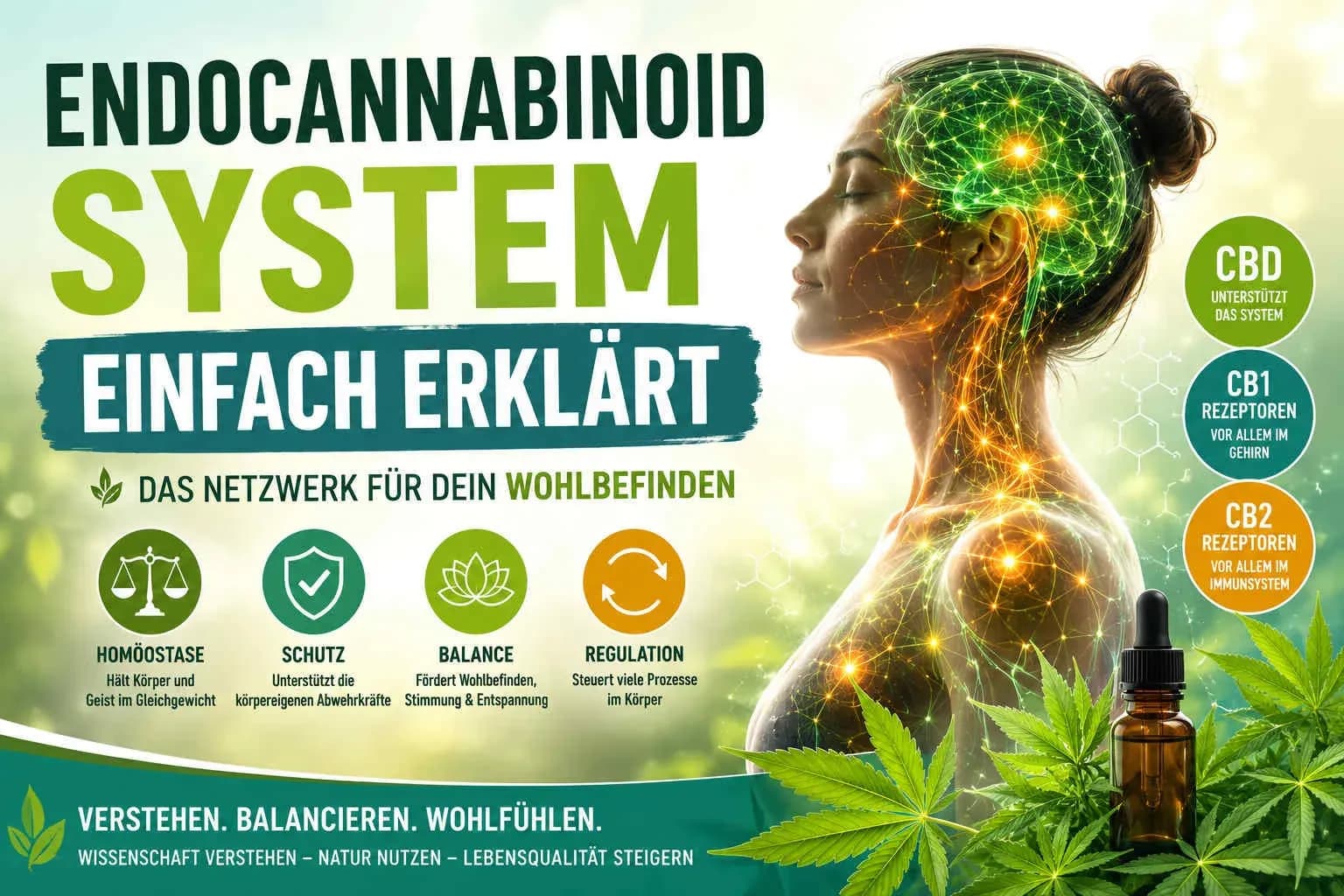
The endocannabinoid system, ECS for short, is the body’s own signalling system made up of three components: receptors, messenger substances produced by the body and enzymes. Its task is regulation – it keeps processes such as pain perception, sleep, appetite, mood and immune response within a stable range.
The name is misleading: the system is called this because it was discovered through cannabis research, not because it has anything to do with cannabis. It exists in all vertebrates and works regardless of whether a hemp plant has ever been nearby.
The three components
Component | What it is | Examples |
Receptors | Docking sites on cell surfaces that receive signals | CB1, CB2 |
Endocannabinoids | Messenger substances that the body produces itself | Anandamide (AEA), 2-arachidonoylglycerol (2-AG) |
Enzymes | Build up and break down the messenger substances | FAAH, MAGL, NAPE-PLD, DAGL |
Together, all three form a system that does not run continuously but switches on when needed and is switched off again immediately afterwards. This short lifespan is not a side effect but the core of how it works.
The receptors: CB1 and CB2
There are two well-characterised cannabinoid receptors. Both belong to the family of G protein-coupled receptors, but they are located in very different places.
CB1 | CB2 | |
Main location | Nervous system, especially the brain | Immune system and peripheral tissues |
Specific locations | Hippocampus, cerebellum, basal ganglia, hypothalamus | Spleen, immune cells, bone tissue |
Also present in | Liver, gastrointestinal tract, adipose tissue, skeletal muscle | Skin, intestine |
Involved in | Memory, motor control, appetite, pain processing | Inflammatory response, immune response |
Binds THC? | Yes, as a partial agonist – this produces the intoxicating effect | Yes, without an intoxicating effect |
First cloned | 1990 | 1993 |
CB1 is one of the most common receptors in the brain. This explains why an intervention in this system can affect so many different processes at the same time.
The body’s own messenger substances
Endocannabinoids are lipid molecules. Unlike most messenger substances, they are not stored in vesicles and released when needed, but are only produced from components of the cell membrane at the moment they are needed.
Anandamide (AEA) | 2-arachidonoylglycerol (2-AG) | |
Discovered | 1992 | 1995 |
Origin of the name | from “ananda”, Sanskrit for bliss | chemical name |
Concentration in tissue | low | considerably higher |
Effect at CB1 | Partial agonist | Full agonist |
Degrading enzyme | FAAH | MAGL |
Synthesising enzyme | NAPE-PLD | DAGL alpha and beta |
The name anandamide has caused a lot of confusion. It is not a happiness molecule and not a drug produced by the body, but a regulator like any other – the name goes back to a poetic choice by its discoverers, not to its function.
The enzymes
The enzymes determine how long a signal lasts. If the degrading enzyme is inhibited, the messenger substance remains active for longer – this is one of the points that pharmacological research is currently working on.
Enzyme | Task | Acts on | Why it is relevant |
FAAH | Breakdown | Anandamide | People with genetically reduced FAAH activity have higher anandamide levels |
MAGL | Breakdown | 2-AG | Inhibition is being studied as a research approach |
NAPE-PLD | Synthesis | Anandamide | determines how quickly it is replenished |
DAGL | Synthesis | 2-AG | is influenced by stress and inflammation |
How the system works – backwards and on demand
This is the point that most descriptions leave out, even though it is what makes the ECS special: it works in the opposite direction to almost all other messenger systems.
Normally, the upstream nerve cell sends a signal to the downstream one. In the endocannabinoid system, it is the other way round. The receiving cell detects that it is being overstimulated, then produces endocannabinoids and sends them back to the sending cell. There they dock onto CB1 and reduce further signal release.
The technical term for this is retrograde signalling. In practice, this means that the ECS is not a drive system but a braking system. It steps in when something gets out of control, and it does so exactly where it gets out of control.
Step | What happens |
1 | The receiving nerve cell is strongly stimulated |
2 | It produces endocannabinoids from its cell membrane – only now, not in advance |
3 | These travel back to the sending cell |
4 | There they bind to CB1 and reduce the release of further messenger substances |
5 | The enzymes break down the endocannabinoids again within a short time |
6 | The signal has ended and the system is ready for the next demand |
How THC and CBD intervene in the system
Plant cannabinoids are chemically similar enough to the body’s own cannabinoids to interact with the same system. How they do so, however, differs fundamentally – and this is where many sources get it wrong.
THC | CBD | |
Binding to CB1 | binds directly as a partial agonist | hardly binds directly |
Mode of action | activates the receptor | modulates it indirectly, described as a negative allosteric modulator |
Intoxicating | yes | no |
Other targets | CB2 | TRPV1, 5-HT1A, GPR55, PPAR-gamma |
Influence on enzymes | low | Inhibition of anandamide breakdown is being discussed |
Effect when combined | stronger on its own | can dampen the effect of THC |
The most important point: CBD does not simply dock onto CB1. This simplification appears in countless product descriptions, but it is wrong. CBD has a very low direct binding affinity for CB1 and CB2. Its effects arise mainly through other pathways – through modulation of the receptor, through enzymes and through receptors that do not belong to the cannabinoid system at all.
A detailed comparison of the two substances is given in the article Difference between THC and CBD. Why CBD is not intoxicating is explained in the article Does CBD contain psychoactive substances.
How the system was discovered
The history of its discovery is short – the ECS is a young field of research. Less than ten years passed between the first receptor discovery and the description of the second messenger substance.
Year | What happened | Significance |
1964 | THC is isolated and its structure described | Starting point of modern cannabis research |
1988 | Binding sites for cannabinoids detected in the brain | First indication that a mechanism produced by the body must exist |
1990 | CB1 receptor cloned | The mechanism is identified at the molecular level |
1992 | Anandamide discovered | The body produces its own cannabinoids |
1993 | CB2 receptor cloned | The system extends beyond the nervous system |
1995 | 2-AG identified | Second messenger substance, dominant in quantity |
from 2000 | Enzymes and further receptors characterised | The picture becomes more complex rather than simpler |
For comparison: the serotonin system has been studied since the 1950s. Research on the ECS is correspondingly at an earlier stage – this should be kept in mind with every statement about health-related connections.
“Clinical endocannabinoid deficiency” – a hypothesis
Many texts state that a deficiency of the body’s own cannabinoids is the cause of migraine, irritable bowel syndrome or fibromyalgia. This idea comes from a hypothesis formulated in 2004 and revised in 2016.
Its status is important: it is a hypothesis, not an established finding. There is no standard test that could measure such a deficiency and no recognised diagnosis. The hypothesis is interesting and is being studied – but it is not suitable as an explanation for complaints, let alone as a sales argument.
If you come across statements online such as “You probably have an endocannabinoid deficiency”, you should put them into perspective accordingly.
Common misconceptions
Statement | Status | What is correct |
“CBD docks onto CB1 and CB2” | false | CBD hardly binds there directly and acts mainly through other pathways |
“The ECS reacts to cannabis” | misleading | The system exists independently of it; cannabis only happens to fit into it |
“Anandamide is the happiness hormone” | false | It is a regulator; the name goes back to its discoverers, not to its function |
“Everyone has an ECS deficiency” | unproven | Clinical endocannabinoid deficiency is a hypothesis without a method of measurement |
“CB2 is only found in the immune system” | simplified | That is where it is concentrated, but CB2 also occurs in other tissues |
“You can top up the ECS with products” | false | It is a regulatory system, not a storage system |
“Only cannabis acts on the ECS” | false | Exercise, diet and sleep also influence endogenous cannabinoid levels |
Why people react so differently to CBD is partly related to the individual make-up of this system – see the article Why does CBD not work for me.
Other cannabinoids and the ECS
CBD and THC are not the only plant cannabinoids that interact with this system. The article on cannabinoids gives an overview; CBG, CBN and CBC are covered individually.
In addition, there are the terpenes, which influence the interplay – described in the article on the entourage effect and terpenes. Which extract type contains which accompanying substances is explained in the comparison of full spectrum, broad spectrum and isolate.
Why the ECS is relevant in practice
Two points from this knowledge have direct consequences.
First, interactions. Because CBD is broken down by liver enzymes that are also responsible for many medicines, taking them at the same time can change the levels of these medicines. This has nothing to do with the ECS itself, but it is part of the overall picture.
Second, individual differences. Receptor density and enzyme activity differ from person to person. This is the most plausible reason why two people take the same amount and describe different experiences.
Interactions are covered in the article CBD interactions with medication. Whether CBD can be addictive is discussed in the article Is CBD addictive.
Legal notice
This article describes physiological fundamentals and the current state of research. It makes no claims about the health effects of individual products. In Switzerland, CBD products are not medicinal products and must not be advertised as such.
The legal framework is summarised in the article Is CBD legal in Switzerland.
Frequently asked questions
What is the endocannabinoid system?
The endocannabinoid system is the body’s own signalling system made up of receptors, self-produced messenger substances and enzymes. Among other things, it regulates pain perception, sleep, appetite, mood and immune response and keeps these processes within a stable range.
Where are CB1 and CB2 receptors located?
CB1 receptors are found mainly in the nervous system, especially in the brain, and also in the liver, digestive tract and muscles. CB2 receptors are located mainly on immune cells as well as in the spleen and bone tissue.
Does CBD bind to the cannabinoid receptors?
Only very weakly. Unlike THC, CBD has a low direct binding affinity for CB1 and CB2. It acts mainly indirectly by modulating the CB1 receptor and by acting on other receptors such as TRPV1 and 5-HT1A.
What are anandamide and 2-AG?
These are the two most important cannabinoids produced by the body. Anandamide was discovered in 1992, 2-AG in 1995. Neither is stored; both are produced from components of the cell membrane when needed and then quickly broken down again.
Is there such a thing as an endocannabinoid deficiency?
The so-called clinical endocannabinoid deficiency is a scientific hypothesis, not an established finding. There is no recognised method of measurement and no established diagnosis.
Do animals also have an endocannabinoid system?
Yes. The system occurs in all vertebrates and is very old in evolutionary terms. In mammals, the CB1 receptor has an almost identical structure across species.
Sources
Matsuda L.A. et al. (1990), article “Structure of a cannabinoid receptor and functional expression of the cloned cDNA”, published in Nature 346:561–564, DOI: 10.1038/346561a0
Devane W.A. et al. (1992), article “Isolation and structure of a brain constituent that binds to the cannabinoid receptor”, published in Science 258:1946–1949, DOI: 10.1126/science.1470919
Munro S., Thomas K.L., Abu-Shaar M. (1993), article “Molecular characterization of a peripheral receptor for cannabinoids”, published in Nature 365:61–65, DOI: 10.1038/365061a0
Mechoulam R. et al. (1995), article “Identification of an endogenous 2-monoglyceride, present in canine gut, that binds to cannabinoid receptors”, published in Biochemical Pharmacology 50:83–90, DOI: 10.1016/0006-2952(95)00109-D
Pertwee R.G. et al. (2010), article “International Union of Basic and Clinical Pharmacology LXXIX – Cannabinoid receptors and their ligands: beyond CB1 and CB2”, published in Pharmacological Reviews 62:588–631, DOI: 10.1124/pr.110.003004
Lu H.-C., Mackie K. (2016), article “An Introduction to the Endogenous Cannabinoid System”, published in Biological Psychiatry 79(7):516–525, DOI: 10.1016/j.biopsych.2015.07.028
Zou S., Kumar U. (2018), article “Cannabinoid Receptors and the Endocannabinoid System – Signaling and Function in the Central Nervous System”, published in International Journal of Molecular Sciences 19(3):833, DOI: 10.3390/ijms19030833
Laprairie R.B. et al. (2015), article “Cannabidiol is a negative allosteric modulator of the cannabinoid CB1 receptor”, published in British Journal of Pharmacology 172(20):4790–4805, DOI: 10.1111/bph.13250
Russo E.B. (2016), article “Clinical Endocannabinoid Deficiency Reconsidered”, published in Cannabis and Cannabinoid Research 1(1):154–165, DOI: 10.1089/can.2016.0009
Further articles on the state of research can be found in our overview of CBD studies.
What this means for use is explained in the guide to CBD effects and areas of use. You can find our range under CBD oil and in the CBD shop.
Categories