CBD Knowledge
CBD Interactions with Medications: What You Should Know
By Vapor Spirit Fachteam
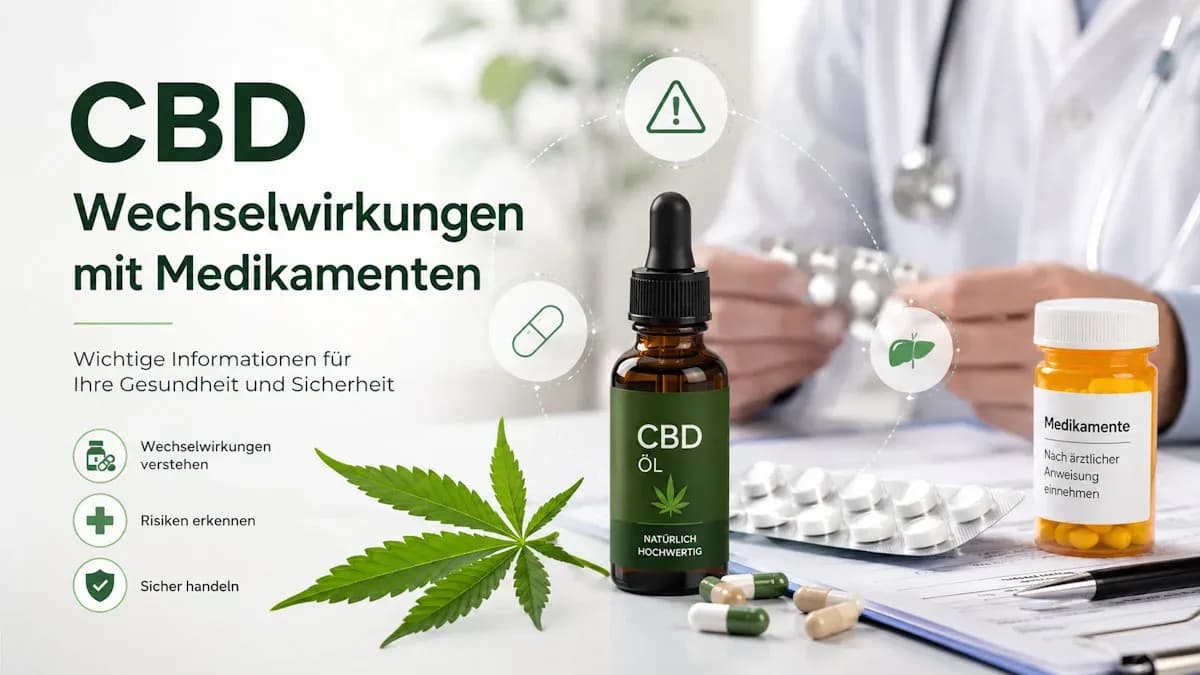
CBD can interact with certain medications because cannabidiol is metabolised in the liver by the cytochrome P450 (CYP450) enzyme system – the same system that also breaks down many drugs. If you take medication regularly, you should therefore discuss taking CBD oil with your doctor or pharmacist beforehand. This article explains objectively and neutrally which interactions are known, which groups of medications may be affected and what you should pay attention to.
Why can CBD interact with medications at all?
Cannabidiol – like around 60 % of all common drugs – is broken down in the liver by the cytochrome P450 enzyme family, in particular by the enzymes CYP3A4 and CYP2C19. If you take CBD and a medication at the same time, both substances compete for the same enzymes.
This can have two effects:
- The drug level rises: The medication is broken down more slowly and has a stronger or longer effect than intended.
- The drug level falls: Less commonly, the effect of a medication can be weakened.
How strong this effect is depends on the CBD dose, the type of medication and individual factors. According to current research, relevant interactions at the usual low doses of over-the-counter CBD oil are less common than with high-dose medical applications – but they cannot be ruled out. You can find more on the scientific background in our overview of CBD studies.
The grapefruit effect: the simple rule of thumb
A helpful guide is the so-called grapefruit test: grapefruit inhibits the same CYP450 enzymes as cannabidiol.
Rule of thumb: If the package leaflet of your medication advises you to avoid grapefruit or grapefruit juice, you should also have the combination with CBD checked by a doctor beforehand.
This rule does not replace a professional consultation, but it is a good first reference point in everyday life.
Which medications may be affected?
The following overview is based on the current state of research. It is not an exhaustive list and does not replace medical advice.
Medication group | Examples | Possible effect |
Blood thinners (anticoagulants) | Warfarin, Marcoumar | Increased effect possible, risk of bleeding may rise |
Blood pressure medications | Beta blockers, calcium channel blockers | Effect may be increased |
Antiepileptic drugs | Clobazam, valproate | Increased drug levels reported |
Antidepressants & sedatives | SSRIs, benzodiazepines | Increased tiredness possible |
Immunosuppressants | Tacrolimus, ciclosporin | Changes in levels possible |
Statins (cholesterol-lowering drugs) | Simvastatin, atorvastatin | Slower breakdown possible |
Acid blockers (PPIs) | Omeprazole | Interaction via CYP2C19 possible |
Painkillers | Ibuprofen, diclofenac | Theoretically relevant at high doses |
Important: «Possible» does not mean «inevitable». Many people combine low-dose CBD with medications without any problems – but your individual situation belongs in the hands of a doctor.
CBD and blood thinners: special caution
The best-documented interaction concerns warfarin (in Switzerland mainly Marcoumar/phenprocoumon). Cannabidiol CBD can slow down its breakdown, which may cause the clotting value (INR) to rise. If you take blood thinners and want to use CBD, you must do so under medical supervision – including close monitoring of your clotting values.
CBD and antidepressants or sleeping pills
Many users describe cannabidiol as relaxing – read more in our article on the effects of CBD oil. In combination with sedating medications (benzodiazepines, certain antidepressants, sleeping pills), tiredness can be amplified additively. This is particularly relevant for your fitness to drive – see also: Are you allowed to drive a car with CBD?
Leaving time between doses: does it help?
Leaving a gap of 2–4 hours between taking your medication and CBD can reduce direct competition in the gastrointestinal tract, but it does not fully solve the underlying problem: CBD remains in the body considerably longer. We explain exactly how long here: How long does CBD stay in the body?
A gap therefore makes sense, but it does not replace consulting your doctor.
Does the form of intake matter?
Yes, in part:
- Sublingual drops (organic CBD oil): absorption through the oral mucosa, moderate bioavailability
- Inhalation (CBD Vape or CBD flower): faster onset, shorter duration of effect – see duration of CBD effects
- External application (CBD Cosmetics): hardly any CBD reaches the bloodstream – interactions are considered very unlikely here
As a general rule: the higher the amount of CBD absorbed into the blood, the more relevant the issue of interactions. You can find tips on a cautious approach in the CBD dosage & intake guide.
CBD and the liver
Since metabolism takes place in the liver, liver health is also an issue. In studies, changes in liver values were observed at very high doses – according to current knowledge, this is not a typical problem with the usual consumption amounts of over-the-counter products. More in-depth information: CBD and the liver.
Checklist: how to play it safe
- Check the package leaflet – is there a grapefruit warning?
- Ask your doctor or pharmacist – especially with blood thinners, antiepileptic drugs, immunosuppressants
- Start with a low dose – and increase slowly («start low, go slow»)
- Watch for signals – have unusual tiredness, dizziness or changes in the effect of your medication checked by a doctor
- Choose quality – lab-tested products with a declared CBD content from a trustworthy source such as a certified CBD shop in Switzerland
You can read more about the undesirable effects of cannabidiol itself under side effects of CBD.
What research says about CBD interactions
Why caution is advised when taking them at the same time
With the simultaneous intake of cannabidiol and medications, caution is advised because both substances are broken down by the same liver enzymes. Various medications can interact with CBD – how strongly depends on the dose and the respective active ingredient. If you have several medications in your body, you should therefore always have the combination checked by a doctor before reaching for CBD oils.
Findings from studies and reviews
A systematic review by Brown & Winterstein (et al.) concludes that CBD can influence the breakdown of certain active ingredients. Much of the knowledge comes from the field of medical cannabis: studies on Dravet syndrome and multiple sclerosis examined high-dose CBD preparations for which relevant interactions are documented. The difference from the over-the-counter range is important – in Switzerland, the latter is subject to a strict THC content limit of below 1 %; more on this under THC content of CBD in Switzerland.
When side effects can occur
The World Health Organization (WHO) generally classifies pure CBD as well tolerated. Nevertheless, side effects can occur in combination with other drugs – for example when a medication is broken down more slowly and therefore has a stronger effect. Whether and how CBD works varies from person to person; unusual combinations can lead to undesirable side effects in individual cases. Pay attention to your body's signals and, if in doubt, talk to your doctor or pharmacist. More on this under side effects of CBD.
FAQ: CBD interactions with medications
Can I take CBD together with medications?
That depends on the medication. Like many drugs, CBD is broken down by the liver's CYP450 enzyme system. Check the combination with your doctor or pharmacist beforehand – especially with blood thinners, antiepileptic drugs and immunosuppressants.
What is the grapefruit effect with CBD?
Grapefruit inhibits the same liver enzymes as CBD. If the package leaflet of your medication contains a grapefruit warning, this indicates that CBD could also affect the breakdown of the medication.
How much time should you leave between CBD and medications?
A gap of 2–4 hours is often recommended. However, since CBD remains detectable in the body for several days, a time gap does not replace consulting your doctor.
Does CBD increase the effect of blood pressure medications?
There are indications that CBD can increase the effect of blood-pressure-lowering medications. If you take blood pressure medication, you should only use CBD after consulting a doctor.
Is using CBD Cosmetics unproblematic while taking medication?
With external application, hardly any CBD reaches the bloodstream. Interactions with medications are therefore considered very unlikely.
Does CBD make you more tired in combination with sleeping pills?
Yes, that is possible. Sedating effects can add up. Caution is particularly advised in road traffic.
Legal notice:
This article is intended solely for general information and does not constitute medical advice. CBD products from Vapor Spirit are not medicinal products and are not intended to diagnose, treat or cure any disease. If you have questions about medications, please contact your doctor or pharmacist.
Categories