CBD Knowledge
CBD and muscle tension – product forms and what studies show
By Vapor Spirit Fachteam
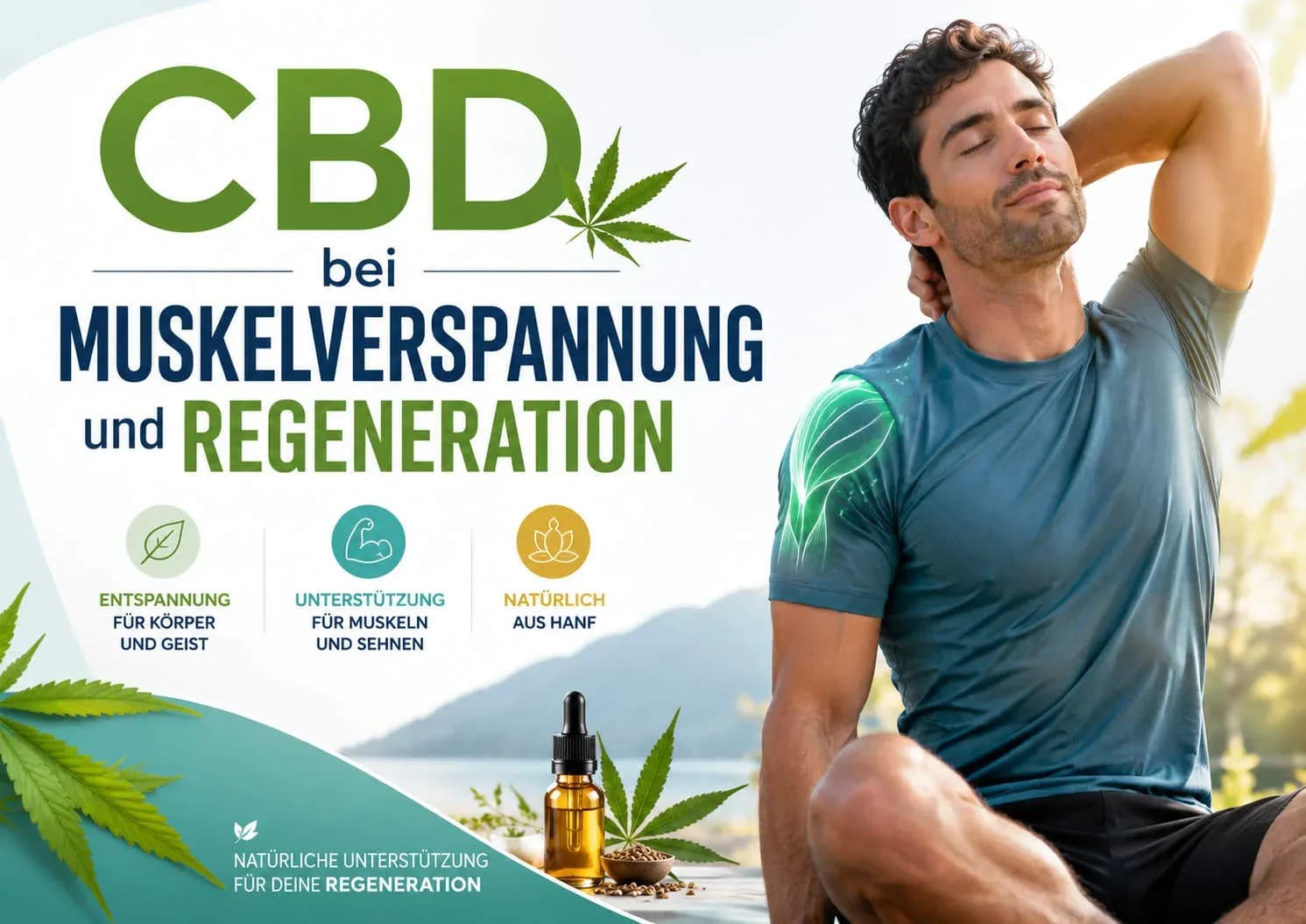
CBD products are available for internal use as oil under the tongue and for external use as a tincture, cream or massage oil. CBD is not a painkiller, is not intended for treating muscle tension and is not authorised as a medicinal product in Switzerland.
This article explains how the application works in practice, which product form is used for what, and what research has actually shown so far – including the limits of this research.
Why muscles become tense
Muscle tension usually comes from one of three directions: too little movement, too much movement or persistent tension caused by stress. The causes differ, but the result feels similar – a hardened, pressure-sensitive muscle with limited mobility.
Trigger | Typical situation | Affected areas |
lack of exercise | long periods of sitting, one-sided posture | neck, shoulders, lower back |
Overload | intensive training, unaccustomed strain | legs, back, arms |
stress | persistent inner tension | jaw, neck, shoulder girdle |
Protective posture | compensatory movement after an injury | varies, often the opposite side |
The connection between stress and tension works in both directions: tension creates stress, and stress increases tension. Exercise, breaks and stress reduction therefore address both sides.
Where CBD acts in the body
CBD interacts with the endocannabinoid system, a network of receptors, enzymes and the body's own messenger substances. Research has so far described several points of action, although the relationships have not been conclusively clarified.
Point of action | What is described there | State of research |
CB1 and CB2 receptors | CBD binds only weakly directly, but modulates receptor activity indirectly | well studied |
TRPV1 | Receptor that also responds to capsaicin and is involved in transmitting stimuli | mainly preclinical |
5-HT1A | Serotonin receptor, discussed in connection with tension and sleep | mainly preclinical |
Inflammatory messengers | In models, CBD influences the release of pro-inflammatory substances | Animal models, little human data |
Important for context: a large share of these findings comes from cell and animal studies. Possible transferability to humans does not mean proof in humans.
Internal or external – which form for what
The choice of product form depends less on what is strongest and more on whether the application should be targeted or general.
Form | Application | Used for | Features |
CBD oil | sublingual | general use throughout the day | Partly absorbed via the oral mucosa |
CBD mother tincture | external, targeted | targeted care | alcohol base, absorbs quickly, cools when applied |
CBD cream | external, over larger areas | larger areas, daily care | contains fat, nourishing, absorbed more slowly |
CBD massage oil | external, with massage | neck, shoulders, back | smooth glide, for longer application |
CBD flower | vaporise | as an aroma product in the evening | fastest onset, shortest duration |
In practice, many users combine an internal base with CBD oil and targeted external application. For the external side, CBD Cosmetics or a CBD tincture are options; for use in the evening, CBD flower.
CBD mother tincture for muscles – why the alcohol base makes the difference
A CBD mother tincture is an alcohol extract of the hemp plant. Instead of a carrier oil, high-proof organic ethanol serves as the solvent that dissolves cannabinoids and terpenes from the plant material. The terms cannabis tincture, hemp tincture and hemp mother tincture refer to the same product.
For use on muscles, the alcohol base has two practical consequences. Firstly, the alcohol evaporates quickly after application, so the tincture is absorbed quickly and leaves no greasy film – unlike a cream. Secondly, the evaporation creates a brief cooling effect on the skin, which many users describe as pleasant.
CBD mother tincture | CBD cream | |
Base | Organic ethanol | Oil and water phase |
Application | targeted, drop by drop | over a larger area |
Absorption | very fast, no film | slower, nourishing film |
Skin feel | brief cooling effect | smooth |
Concentration | high, a few drops are enough | lower, larger amount |
Suitable for | targeted application | entire areas, daily care |
A note on the skin: alcohol dries it out. For sensitive or irritated skin, open wounds and the face, the tincture is not the right choice. Before the first use, a tolerance test in the crook of the arm is recommended.
Historically, hemp tinctures are not a new invention – alcohol extracts of cannabis were part of the standard range of European pharmacies in the 19th century. Our CBD mother tincture from Swiss organic cultivation takes up this method.
Application step by step
Step | What to do | Why |
1 | Clean and dry the skin | Residues of cream or sweat hinder absorption |
2 | A few drops on the desired area of skin | targeted rather than over a large area – the tincture is concentrated |
3 | Massage in for two to three minutes | the massage itself is part of the application |
4 | Let it absorb, do not cover | the alcohol must be able to evaporate |
5 | Repeat once or twice a day if needed | regular application is more common than a large single amount |
If you want to combine the application with a longer massage, the article Making your own CBD massage oil provides instructions for a smoother-gliding variant.
Dosage – guidance, not a rule
There is no universally valid CBD dosage. What suits you depends on body weight, individual sensitivity, product concentration and form of application. The principle common in the literature and in practice is: start low and increase slowly.
Application | Usual approach | Adjustment |
Internal, getting started | small amount, once a day in the evening | assess after 5–7 days |
Internal, established | split into two doses | increase gradually, not in jumps |
External, tincture | a few drops per area | increase the frequency, not the amount per application |
External, cream | apply thinly | depending on skin tolerance |
This is covered in detail in the guide to CBD dosage and intake. Possible side effects are described in the article on CBD side effects.
What the research actually shows
There is less research on the external application of CBD than product advertising suggests – but more than nothing. The following four studies are the most relevant for this topic. The full references with DOI are listed at the end of the article.
Study | Examined | Result | Limitation |
Nitecka-Buchta et al. 2019 | CBD gel applied externally to the masticatory muscles, randomised and double-blind | Reduced muscle activity and lower pain ratings compared with placebo | 60 participants, jaw muscles only, short duration |
Hammell et al. 2016 | Transdermal CBD gel in an animal model | Dose-dependent reduction in joint swelling and inflammatory markers | Rats, not humans |
Xu et al. 2020 | CBD oil applied externally for nerve pain in the legs, randomised | Greater reduction in symptoms than with placebo | 29 participants, a different type of pain than muscle tension |
Heineman et al. 2022 | CBD cream for thumb base joint osteoarthritis, randomised | Better scores than placebo for pain and function | 18 participants, joint rather than muscle |
What can and cannot be concluded from this
● There are controlled human studies on the external application of CBD – the claim that there is no evidence at all is not true.
● All available human studies are small. With 18 to 60 participants, no universally valid conclusions can be drawn.
● Only one study directly examines the muscles. The others concern joints or nerve pain and cannot be transferred one to one.
● None of these studies makes CBD a medicinal product. They show indications, not evidence sufficient for approval.
If you are interested in the research on joint complaints, you will find more in the article on CBD for arthrosis and rheumatism. The general overview of pain and inflammation is in the article CBD for pain and inflammation.
CBD in sport and recovery
For physically active users, the doping question is usually the first concern. The answer is clear: the World Anti-Doping Agency removed cannabidiol from the prohibited list as of 1 January 2018. CBD itself is therefore not banned in competition.
The key is the restriction behind it: all other cannabinoids, including THC, remain on the list. Full spectrum products contain small amounts of THC. Anyone active in tested competitive sport therefore chooses THC-free products and asks to see the certificate of analysis.
The difference between full spectrum, broad spectrum and isolate is crucial here and is explained in the article Full spectrum, broad spectrum and isolate compared. On training and muscle building, there is also the article CBD in sport and bodybuilding, and on recovery after training the article CBD for sore muscles.
When medical assessment is necessary
Muscle tension is usually harmless and eases after days to weeks. In the following cases, the cause should be clarified before any product is used:
● Symptoms persist for more than two to three weeks without improvement.
● Numbness, tingling or loss of strength occur.
● The symptoms began after a fall or accident.
● Fever, unexplained weight loss or symptoms at night also occur.
● The pain radiates into the arm or leg.
If you take medication regularly, clarify the combination in advance. CBD is broken down by the same liver enzymes as many medicines – the details are in the article on CBD interactions with medication.
Legal framework in Switzerland
CBD products are legally available in Switzerland as long as the THC content is below one percent. They are not medicinal products and must not be advertised as such. A product advertised for the treatment of diseases would require approval from Swissmedic.
The article CBD legal in Switzerland summarises the complete framework.
This article provides information about application and the state of research. It does not constitute a medical recommendation and does not replace medical advice.
Frequently asked questions
What is known about CBD and muscle tension?
CBD is not a painkiller and is not authorised as a medicinal product. There are small controlled studies on external application that investigate a possible muscle-relaxing effect – however, the data are limited and do not allow any general conclusions.
What is a CBD mother tincture?
A CBD mother tincture is an alcohol extract of the hemp plant. Instead of a carrier oil, high-proof ethanol is used as the solvent. It is applied externally and in a targeted way, absorbs quickly and leaves no greasy film.
What is the difference between CBD tincture and CBD oil?
The base. A tincture uses alcohol as a solvent and is intended for external application. CBD oil uses a carrier oil and is placed under the tongue. Both contain cannabidiol, but differ in application and absorption.
How quickly is a CBD tincture absorbed?
Thanks to its alcohol base, a tincture is absorbed within a few minutes; the evaporation creates a brief cooling effect. Oil taken sublingually is partly absorbed via the oral mucosa. An effect against tension has not been proven.
Is CBD allowed in sport?
Yes. The World Anti-Doping Agency removed cannabidiol from the prohibited list as of 1 January 2018. All other cannabinoids, including THC, remain prohibited – in tested competitive sport, THC-free products are therefore the safe choice.
Can I use CBD oil and CBD mother tincture at the same time?
Many users combine an internal base with targeted external application. If you take medication regularly, you should have the combination checked by a doctor in advance.
CBD muscle tension
You can find our CBD mother tincture from Swiss organic cultivation and the rest of our range in the CBD shop. You can get advice in our CBD store in Zurich-Wipkingen.
Categories