CBD Knowledge
CBD Oil Side Effects – What Can Occur and How Often
By Vapor Spirit Fachteam
The most frequently documented side effects of CBD are tiredness, diarrhoea and changes in appetite or weight. They are dose-dependent, are usually mild and subside again after stopping or reducing the amount.
This article summarises what research shows about the tolerability of cannabidiol, how common individual side effects are, in which cases caution is advised and what can be done if something occurs. It describes the state of research and does not replace medical advice.
The most common side effects at a glance
The following overview is based on two large reviews that together evaluated several hundred individual studies. The frequency data come mainly from clinical studies with much higher doses than are usual in everyday use.
Side effect | Frequency | When it occurs | What usually helps |
tiredness | most frequently reported | mainly at the beginning and with larger amounts | Move intake to the evening, reduce the amount |
Diarrhoea, soft stools | common | mostly with oral intake, often caused by the carrier oil | smaller amount, take with a meal |
Change in appetite or weight | common | with prolonged use | monitor, adjust the amount |
Dry mouth | occasional | shortly after sublingual intake | drink, hold the oil under the tongue for longer |
Mild dizziness | occasional | with larger amounts, partly related to blood pressure | Reduce the amount, stand up slowly |
Nausea | rare | on an empty stomach | take with a meal |
Skin reaction | rare | with external application | stop using, check the ingredients |
Changed liver values | rare, dose-dependent | with very large amounts or pre-existing conditions | have it checked by a doctor |
Important for context: “common” here means that the side effect was regularly mentioned in studies – not that it occurs in most users. At the amounts usual in everyday use, side effects are the exception.
What CBD does not affect according to current data
Just as revealing as the list of side effects is the list of what was explicitly not changed in the reviews. These points are rarely mentioned but are central for putting things into context.
Parameter | Finding in the literature |
Heart rate | not changed |
Blood pressure | not relevantly changed at rest |
Body temperature | not changed |
Psychomotor function | not impaired |
Mental function | not impaired |
Gastrointestinal transit | not changed |
Potential for dependence | not present according to the WHO |
Another reference point: in studies, daily amounts of up to 1500 milligrams were administered over longer periods and described as well tolerated. For comparison – in everyday use, usual amounts are in the range of 10 to 50 milligrams per day.
Why the dose is decisive
Almost all the side effects described are dose-dependent. This is the most important practical finding from the research: if you start low and increase slowly, you will not encounter most side effects in the first place.
The basic principle is to start with a small amount and only increase it after several days. How this works in practice is explained in the guide to CBD dosage and intake. What happens with too large an amount is covered in the article on CBD overdose and safety. How to convert percentages into milligrams is explained in the article on the meaning of the percentage in CBD.
When caution is advised
There are situations in which CBD should not be used without consulting a doctor.
Situation | Reason | Recommendation |
Pregnancy and breastfeeding | There is insufficient safety data | Use not recommended |
Children and adolescents | No reliable data outside of medical use | Only when prescribed by a doctor |
Existing liver disease | CBD is metabolised by the liver | Consult a doctor beforehand |
Regular use of medication | Interaction via the cytochrome P450 system possible | Consult a doctor beforehand |
Before driving, first use | Tiredness possible; CBD products may also contain traces of THC | Do not drive a vehicle after intake |
Planned surgery | Possible interaction with anaesthetics | Inform the treating team |
There is a separate article on the liver, CBD and the liver, and on pregnancy, the article CBD during pregnancy. The legal situation for driving is covered in the article Can you drive with CBD.
Interactions with medication
The most practically relevant point with CBD is not the side effect itself, but the interaction. CBD inhibits certain liver enzymes through which a large proportion of all medicines are broken down. As a result, the active substance level of a medication can rise or fall – so the effect concerns the medication, not the CBD.
This is particularly important with blood thinners, antiepileptics, antidepressants, immunosuppressants and sedatives. With the latter, tiredness can be mutually intensified.
The connections, including an overview of substances, are described in the article on CBD interactions with medication. For the combination with alcohol, there is the article Combining CBD and alcohol.
Side effects by form of use
Not every form of use brings the same side effects. The difference lies in how much CBD actually enters the bloodstream.
Form | Absorption | Typical side effect | Risk of interaction |
Oil, sublingual | medium | Tiredness, dry mouth | relevant |
Capsules | lower, delayed | Digestive complaints | relevant |
Vaporising flower | high, fast | Irritation of the airways, coughing | relevant |
Vape | high, fast | Irritation of the airways | relevant |
Cosmetics, cream | very low systemically | local skin reaction | very low |
Tincture, external | very low systemically | dry skin due to alcohol | very low |
If you want to avoid side effects but still do not want to do without CBD, you can therefore often switch to CBD Cosmetics – with these, hardly any CBD enters the bloodstream.
What to do if side effects occur
Step | What to do | Why |
1 | Halve the amount, do not stop immediately | Most side effects are dose-dependent |
2 | Change the time of intake | Tiredness is less disruptive in the evening than during the day |
3 | Take with a meal | Significantly reduces digestive complaints |
4 | Observe for three to five days | Many effects disappear once the body has adjusted |
5 | If it persists: stop and consult a doctor | There could also be another cause |
Not every side effect comes from the CBD
One point that is rarely addressed: a CBD oil does not consist of cannabidiol alone. What is perceived as a side effect is, in practice, often due to other ingredients.
● The carrier oil. Coconut-based MCT oil leads to soft stools in sensitive people – this is regularly attributed to the CBD.
● Flavourings and additives. Especially in flavoured oils and liquids.
● Residues from cultivation. Pesticides or solvent residues if no laboratory analysis is available.
● Unwanted conversion products that can arise from improper processing.
How to recognise poor-quality goods is explained in the article on inferior CBD products. On the subject of conversion products, there is the article on pure CBD flower without trans-cannabinoids. Which accompanying substances each extract form contains is explained in the comparison of full spectrum, broad spectrum and isolate.
If you want to rule out THC completely, you will find this in our range as organic CBD oil without THC. If, on the other hand, you notice nothing at all, the article Why does CBD not work for me is worth reading.
What the studies show
Study | Scope | Key finding | Limitation |
Bergamaschi et al. 2011 | Review of 132 papers | CBD well tolerated, even in large amounts over long periods | mainly older studies |
Iffland & Grotenhermen 2017 | Update focusing on clinical studies | Most common effects: tiredness, diarrhoea, change in appetite | mostly epilepsy and psychosis studies with high doses |
Huestis et al. 2019 | Review of adverse effects | Interactions are a bigger issue than direct side effects | Review, no data of its own |
WHO ECDD 2018 | Assessment report | No potential for dependence, favourable safety profile | As of 2018 |
What can and cannot be concluded from this:
● Tolerability has been well studied – better than for most plant-based products.
● The data come mainly from studies with very high doses. For everyday use, they are therefore rather conservative.
● Long-term data covering several years are largely lacking.
● Well tolerated does not mean ineffective, nor does it mean risk-free – interactions remain the critical point.
Legal framework in Switzerland
CBD products are legally available in Switzerland as long as the THC content is below one percent. They are not medicines, are not approved as such and may not be advertised as such.
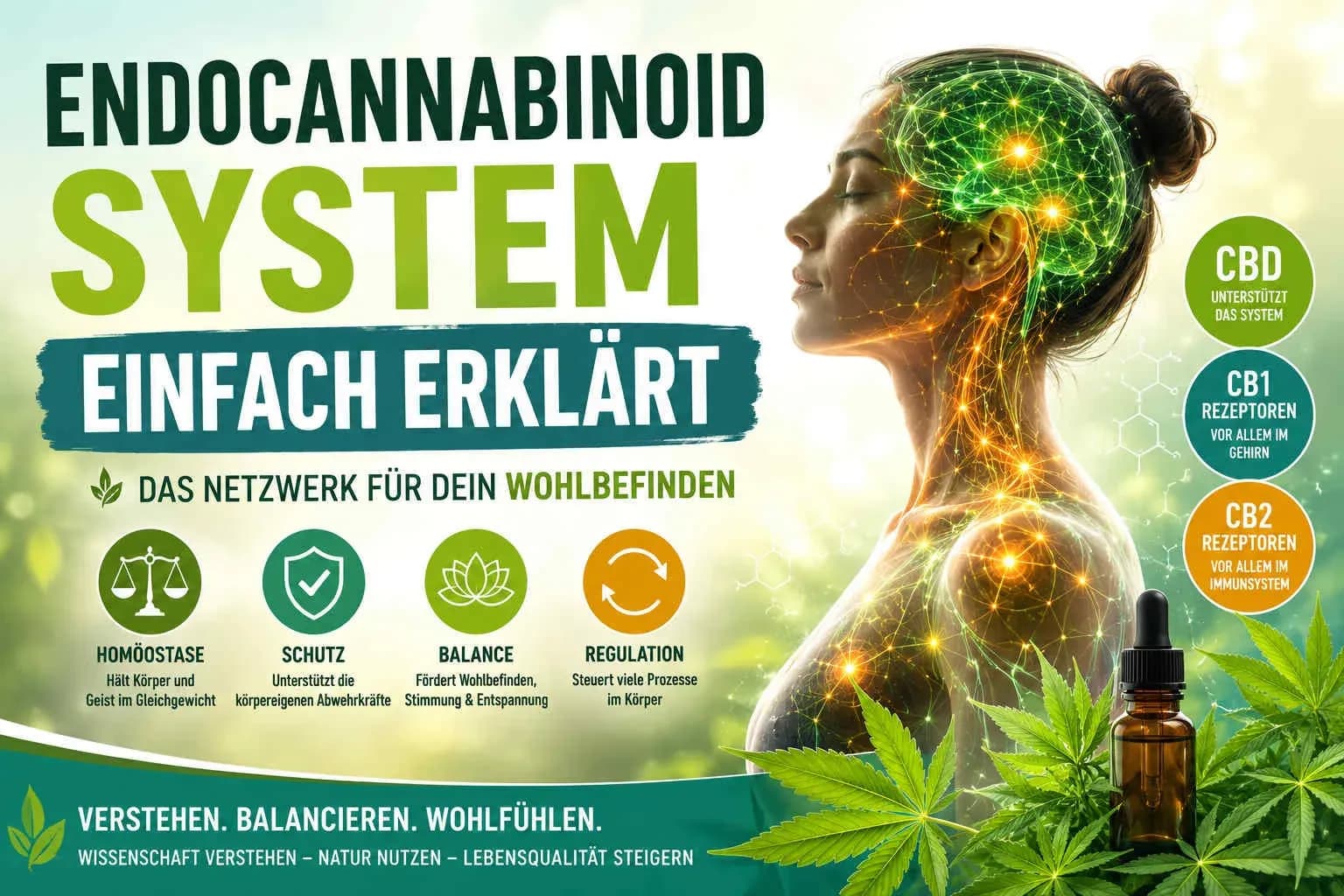
The complete framework is summarised in the article CBD legal in Switzerland. How CBD acts in the body in the first place is explained in the article on the endocannabinoid system.
This article provides information on the state of research. It does not constitute a medical recommendation and does not replace medical advice. If you experience complaints after taking it, having it checked by a doctor is the right course of action.
Frequently asked questions
What side effects does CBD oil have?
The most frequently documented are tiredness, diarrhoea and changes in appetite or weight. Dry mouth, mild dizziness or nausea occur less often. Most effects are dose-dependent and mild.
Is CBD harmful?
According to the current state of research, CBD is considered well tolerated. Even large amounts over longer periods were tolerated in studies without serious side effects. The critical point is not the direct side effects but interactions with medication.
Does CBD make you tired?
Tiredness is the most frequently reported side effect, but it occurs mainly at the beginning and with larger amounts. Many users therefore move their intake to the evening.
Does CBD harm the kidneys?
There is currently no scientific evidence that CBD damages the kidneys. CBD is mainly metabolised by the liver. If you have existing kidney disease, it still makes sense to consult a doctor.
How long do side effects last?
As a rule, they subside within a few hours and disappear completely after a few days of adjustment. If they last longer than a week, use should be paused and the cause clarified.
Can you become dependent on CBD?
No. In its assessment, the World Health Organization concluded that cannabidiol has no potential for dependence.
Sources
Bergamaschi M.M. et al. (2011): Safety and Side Effects of Cannabidiol, a Cannabis sativa Constituent. Current Drug Safety 6(4):237–249. DOI 10.2174/157488611798280924
Iffland K., Grotenhermen F. (2017): An Update on Safety and Side Effects of Cannabidiol – A Review of Clinical Data and Relevant Animal Studies. Cannabis and Cannabinoid Research 2(1):139–154. DOI 10.1089/can.2016.0034
Huestis M.A. et al. (2019): Cannabidiol Adverse Effects and Toxicity. Current Neuropharmacology 17(10):974–989. DOI 10.2174/1570159X17666190603171901
Brown J.D., Winterstein A.G. (2019): Potential Adverse Drug Events and Drug–Drug Interactions with Medical and Consumer Cannabidiol Use. Journal of Clinical Medicine 8(7):989. DOI 10.3390/jcm8070989
World Health Organization, Expert Committee on Drug Dependence (2018): Cannabidiol – Critical Review Report.
CBD oil side effects
You can find our range of organic CBD oils under CBD oil, and the complete overview in the CBD shop. You can get advice in our CBD store in Zurich-Wipkingen.
Categories