Effects & Health
Why doesn't CBD work for me? – Causes, solutions and tips
By Vapor Spirit Fachteam
Why doesn't CBD work for me? The most common reasons
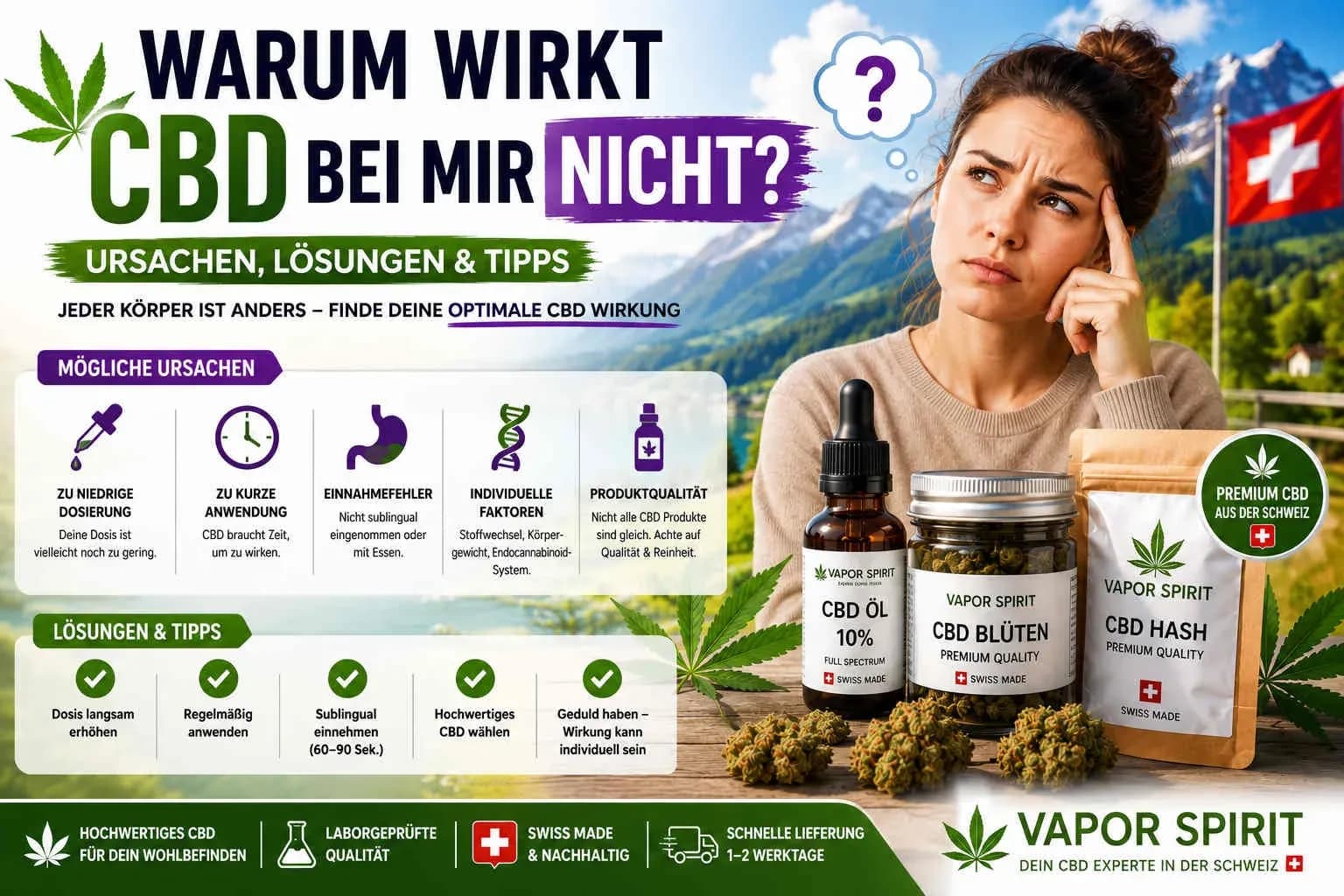
If CBD does not bring you any noticeable change, this is usually due to one of four points: the dose is still too low, the period of use too short, the method of intake not optimal or the expectations too high. An immediate, clear change is not to be expected with CBD – many users only report changes after two to four weeks of regular use, and these are often subtle. There are also people for whom CBD has no effect at all. That is possible too.
The most common reasons at a glance
Before you switch products, it is worth looking at these points. The explanation can usually be found here:
Possible reason | How you recognise it | What you can change |
Dose too low | The same small number of drops for weeks | Increase gradually, observing for a few days each time |
Period of use too short | Only used for a few days so far | Use regularly for two to four weeks |
Intake technique | Drops are swallowed immediately | Keep under the tongue for about 60 seconds |
Irregular use | Taken only when needed | Choose fixed times of day |
Product and spectrum | No certificate of analysis, unclear labelling | Choose a lab-tested product with a clearly stated CBD content |
Storage | Bottle was kept in a bright or warm place, oil smells rancid | Store in a cool, dark place, replace old oil |
Expectations | A clearly noticeable effect is expected | Pay attention to subtle changes, keep notes |
Individual factors | Metabolism, habits, concurrent medication | Discuss with a doctor or pharmacist |
Reason 1: The dosage is not right yet
There is no single CBD dose that suits everyone. Body weight, metabolism and individual sensitivity vary greatly – some users manage with a few milligrams, others need considerably more. If you stay at two drops for weeks because you fear side effects, you may be below the amount at which anything becomes noticeable at all.
The principle "start low, go slow" has proven useful: begin with a small dose and increase it slightly every few days until something changes. It is important to stay at the new amount for a few days each time instead of increasing it daily. The guide to CBD oil dosage and intake shows you how to calculate your amount in milligrams.
Reason 2: The period of use was too short
Many people judge CBD after three or four days. In most cases, that is too early. User reports suggest that a meaningful assessment can only be made after two to four weeks – with daily use and a consistent dose.
A simple log helps: every day, note your dose, the time of day and how you feel. After three weeks, looking back, you will recognise patterns that you miss in everyday life. Gradual changes like these are often overlooked without notes.
Reason 3: The intake technique
The most common technical mistake with oils: the drops are swallowed immediately. The CBD then enters the circulation via the digestive tract and the liver, where a considerable part is broken down before it can take effect. If, on the other hand, the oil is held under the tongue for about 60 seconds, a portion enters the bloodstream directly via the oral mucosa.
The product form you choose also influences when and for how long something is noticeable:
Form of intake | Onset of effect | Duration | Typical for |
Oil, sublingual | approx. 15–45 minutes | several hours | daily use |
Oil, swallowed | approx. 45–90 minutes | longer lasting | unintentional with incorrect technique |
Vape or flower | a few minutes | shorter | short-term use |
Capsules and edibles | approx. 1–2 hours | longest | consistent intake |
Cream or balm | local, not systemic | — | external use |
You can find more on this in the article on how long CBD takes effect. The time of day can also play a role – more on this under taking CBD oil in the morning or evening.
Reason 4: Product quality and spectrum
Not every product contains what is on the label. Without an independent laboratory analysis, the actual CBD content cannot be verified – and an oil with significantly less CBD than stated simply explains a lack of effect through underdosing. So check whether a certificate of analysis is available for your batch and whether the batch number matches. The article on CBD laboratory analysis explains how to read such a certificate.
The spectrum can also make a difference. Full spectrum products contain other cannabinoids and terpenes in addition to CBD, while isolates lack these accompanying substances. Whether and how strongly this has an effect has not been conclusively clarified by science – the approach behind it is described in the article on the entourage effect. The carrier oil also plays a role, see MCT oil or hemp seed oil.
Reason 5: Irregular intake
If you only use CBD occasionally, it is hard to arrive at a reliable assessment. A fixed routine – for example always after breakfast or before going to bed – creates comparable conditions and prevents missed doses. Only then can you judge whether anything is happening at all.
Reason 6: Expectations
CBD is not intoxicating. If you are waiting for a clearly noticeable effect like the one known from some medications, you will not find it. Users tend to describe it more as "less tense" or "calmer in the evening" – changes that are often only noticed in hindsight.
To be honest: there are people for whom CBD changes nothing, even with correct use. The evidence for many areas of use is incomplete, and individual differences are large. This is not a mistake in use, but a realistic outcome.
Reason 7: Storage and shelf life
CBD oil is sensitive to light, heat and oxygen. A bottle that has stood on the windowsill or next to the stove for months may have lost quality. Signs include a rancid smell, a clearly changed taste or noticeable discolouration. Store oils in a cool, dark place, tightly closed, and observe the shelf life after opening.
Reason 8: Individual factors and concurrent medication
Metabolism, diet and lifestyle habits influence how the body absorbs CBD. Since CBD is fat-soluble, taking it with a fatty meal can improve absorption. Existing medication is also relevant: CBD can affect liver enzymes that also break down other active substances. If you take medication, you should therefore clarify its use with a doctor beforehand – background information can be found in the article on CBD and interactions with medications.
When you should seek medical advice
CBD is not a medicinal product and is not intended to treat diseases. If you turn to CBD because of persistent complaints and no change occurs, this is a good moment for a medical consultation – not for a higher dose. This applies especially to pain, sleep problems or psychological strain that last for a longer period. A prescribed therapy should never be replaced by CBD or discontinued on your own initiative.
Frequently asked questions
How long does it take for CBD to work?
Depending on the form, individual doses are noticeable after 15 minutes to 2 hours. For an assessment over several weeks, many users recommend a period of two to four weeks of regular use.
Is it possible that CBD does not work for me at all?
Yes. Individual differences are large, and there are people who notice no change even with correct use and a sufficient dose.
Should I simply increase the dose?
A gradual increase is common, but it does not make sense indefinitely. If nothing happens even after several weeks and an adjusted dose, changing your approach makes more sense than further increases – with medical supervision in the case of health complaints.
Does it make a difference whether I take full spectrum or isolate?
Full spectrum contains additional cannabinoids and terpenes, isolate only pure CBD. Whether this results in a noticeable difference has not been conclusively clarified by science, but many users describe one.
Can other medications make CBD ineffective?
CBD and various medications are partly broken down by the same liver enzymes, which means they can influence each other. This question belongs in a medical or pharmaceutical consultation.
How can I tell whether my CBD oil is still good?
By its smell, taste and colour. A rancid smell, unusual bitterness or strong discolouration indicate oxidation. Cool, dark storage extends the shelf life.
Conclusion: If the hoped-for effect does not occur, it is worth looking first at dose, duration, technique and product quality – in that order. A certificate of analysis provides clarity about what is actually in the product. You can find our lab-tested organic CBD oils from Swiss cultivation in the shop; if you have questions about use, our team can be reached by phone and via WhatsApp.
Note: CBD products are not medicinal products and are not intended to treat, alleviate or prevent diseases. This article is for general information only, does not replace medical advice and refers to the legal situation in Switzerland. If you have health complaints, contact a medical professional. Sale to adults only. Last reviewed: July 2026.
Categories