CBD Knowledge
Understanding a CBD Lab Analysis: How to Read a COA Correctly
By Vapor Spirit Fachteam
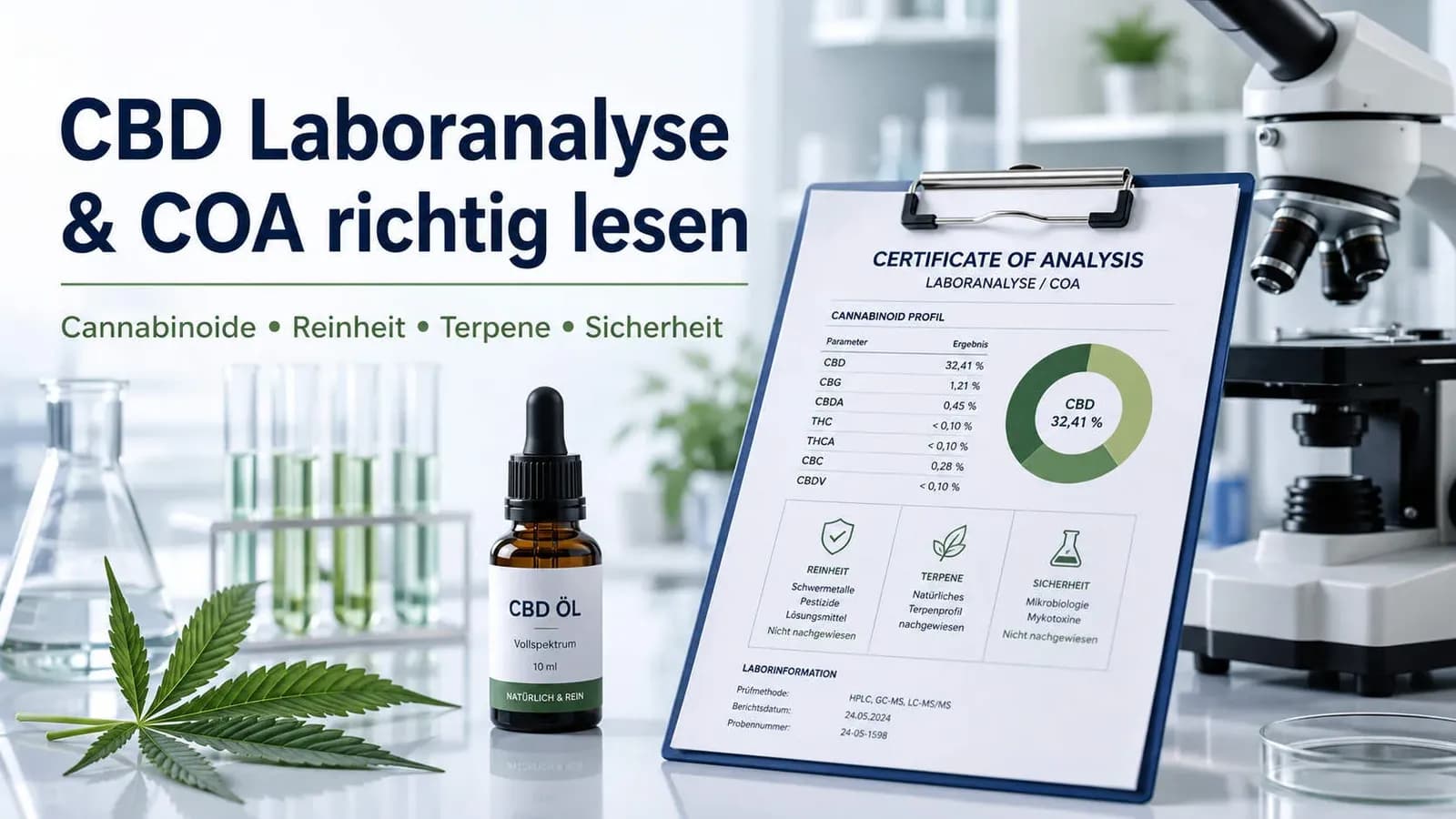
A COA (Certificate of Analysis) is the analysis certificate of an independent laboratory and the only objective proof of what is really in a CBD product. The three most important checkpoints: does the CBD content match the label, is the THC below the legal limit, and are heavy metals and pesticides undetectable? Reputable suppliers make these certificates openly available.
What is a COA and why is it so important?
In Switzerland, CBD products are not approved as medicinal products and are not subject to official batch testing like medicines. Quality control therefore lies with the manufacturer – and with the customer. A COA from an independent, accredited laboratory shows in black and white which cannabinoids are contained in which concentration and whether the product is free of contaminants. Without a COA, you are buying blind.
The sections of a COA at a glance
How to navigate the document – most certificates follow this structure:
Section in the COA | What it contains | What to look for |
Cannabinoid profile | Content of CBD, THC, CBG, CBN, etc. in % or mg/g | Does the CBD value match the label information (±10 %)? |
THC content | Total THC incl. THCA | Switzerland: below 1 % — for export to the EU usually below 0,2–0,3 % |
Terpene profile | Aroma compounds such as myrcene, limonene, caryophyllene | Present in genuine full spectrum products |
Heavy metals | Lead, cadmium, mercury, arsenic | All values below the detection or limit threshold |
Pesticides | Residues of plant protection products | “not detectable” / below limit |
Microbiology | Germs, mould, yeasts | Within food safety limits |
Laboratory & date | Name of the laboratory, date of analysis, batch number | Independent laboratory? Batch identical to your product? No older than ~1–2 years |
Step by step: checking the CBD content
In the cannabinoid profile, look for the line “CBD” and compare the value with the label. An example: a 10-ml bottle with “10 % CBD” should contain around 1000 mg CBD – in the COA this is often shown as 100 mg/ml or 10 g/100 g. Deviations of up to ten percent are normal due to production. Larger deviations are a warning sign. You can calculate how much of this CBD you take daily with our guide on CBD oil dosage and intake.
THC limit: Switzerland vs. EU
In Switzerland, a THC limit of below 1 percent applies to CBD products – significantly higher than in the EU with 0,2 to 0,3 percent. In the COA you will find the total THC value (including the acid form THCA). Important for frequent travellers: a product that is legal in Switzerland may exceed the local limit abroad. You can read details on the legal situation in our article Is CBD legal in Switzerland?.
Recognising full spectrum: terpenes and minor cannabinoids
A genuine full spectrum product shows not only CBD in the COA, but also minor cannabinoids such as CBG, CBC or CBN as well as a terpene profile. If these values are missing entirely, it is usually an isolate product. Our article on the entourage effect explains why the interaction of plant compounds is crucial.
Red flags: when you should not buy
Watch out for these warning signs: no COA is available at all, or only on request. The certificate comes from the manufacturer itself instead of an independent laboratory. The batch number on the COA does not match your product. The analysis date is many years old. Or only the cannabinoid profile was tested, but no contaminants. Reputable Swiss suppliers have every batch fully analysed.
How we do it at Vapor Spirit
Our organic CBD oils are made from Swiss hemp in organic and Demeter quality and tested by independent laboratories for cannabinoid content and purity. We make the analyses transparently available – if you have questions about a specific batch, our team will be happy to help by phone or WhatsApp. You can find out which carrier oil is used in our carrier oil comparison MCT vs. hemp seed oil.
Frequently asked questions about the COA
Where can I find the COA for my product?
With reputable shops, directly on the product page, via a QR code on the packaging or on request from customer service – always with the matching batch number.
What does “n.d.” or “<LOQ” mean in the certificate?
“n.d.” means “not detectable”, “<LOQ” means below the laboratory's limit of quantification. Both are the best possible result for contaminants.
Does every batch have to be tested individually?
Yes, that is the gold standard. Cannabinoid levels vary from harvest to harvest – an old certificate from a different batch says nothing about your bottle.
What is the difference between mg/g and percent?
10 mg/g corresponds to 1 percent. An oil with 100 mg/ml CBD therefore has around 10 percent – this way you can directly compare values from different laboratories.
Do Swiss authorities test CBD products?
Cantonal laboratories carry out spot checks, but there is no systematic batch testing as with medicines. That is why the independent COA remains the most important proof of quality.
Conclusion: A complete, up-to-date COA from an independent laboratory is the most important quality feature when you buy CBD – more important than any advertising promise. Check the CBD content, THC value and contaminant analyses before you buy. You can find all our lab-tested organic CBD oils in our shop.
Note: CBD products are not remedies and do not replace medical advice. This article is for general information purposes only. Last reviewed: July 2026.
Categories