Effects & Health
Is CBD addictive? The complete fact check
By Vapor Spirit Fachteam
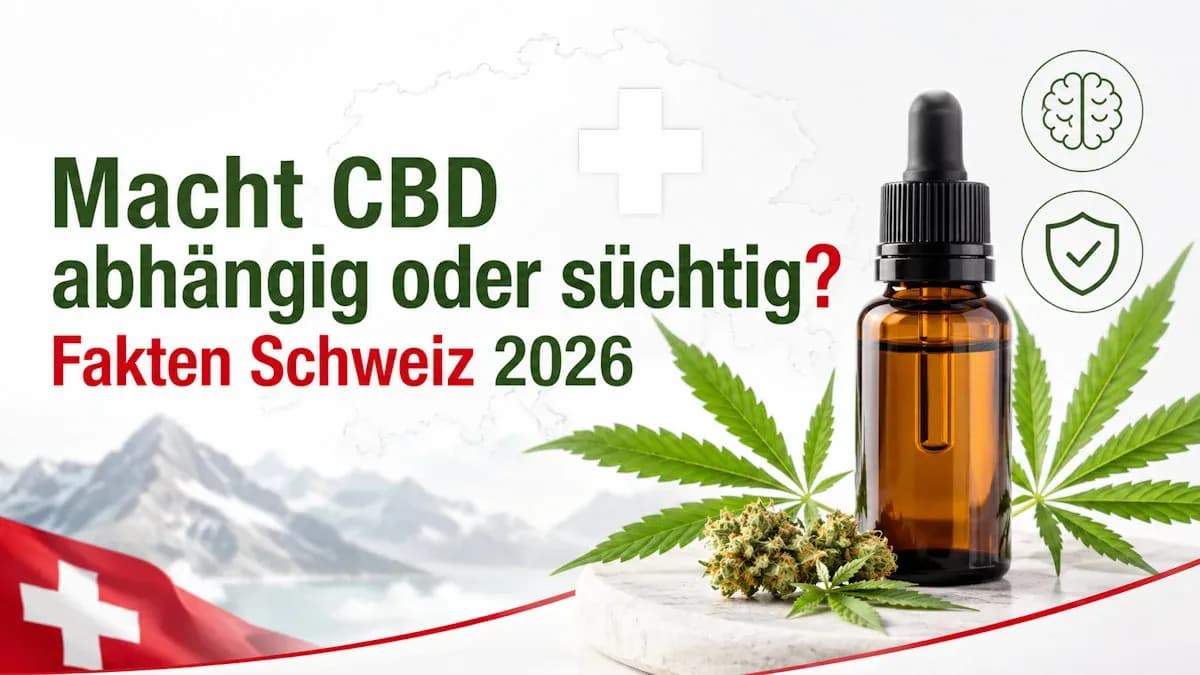
Is CBD addictive? What science & the WHO say about CBD addiction
Note: This article is for general information only and does not replace medical advice. CBD products are not medicinal products.
Whether CBD oil, CBD flower or capsules – the question “does CBD cause dependence?” or “is CBD addictive?” is one of the most frequently asked about cannabidiol. The short answer first: according to current scientific knowledge, pure, legal CBD shows no classic potential for dependence. The World Health Organization came to a similar conclusion in its assessment. So that this statement does not simply stand unsupported, we look below at what dependence actually means medically, why CBD works differently from THC, and how you can use CBD drops or other products so that no habituation develops in the first place.
What does dependence actually mean?
Medicine distinguishes between two forms. With psychological dependence, there is a strong mental craving for a substance in order to feel better. With physical dependence, the body has become so used to a substance that real withdrawal symptoms occur when it is stopped. Professionally, an addictive disorder is usually only diagnosed when several criteria are met at the same time: loss of control over the amount, development of tolerance, withdrawal symptoms and a persistent craving despite negative consequences. Classic examples of substances with real potential for dependence are nicotine, alcohol or opioids.
Can you become dependent on CBD?
No – according to current research, this is considered very unlikely. The decisive difference lies in the mechanism of action: addictive substances such as nicotine or THC bind directly to the CB1 receptors in the brain and thereby trigger a strong release of dopamine in the reward system – it is precisely this mechanism that drives classic addiction processes. CBD behaves fundamentally differently here: it does not activate these receptors directly but, according to current understanding, interacts rather indirectly with the body's own endocannabinoid system, whose role is still being researched. Because this typical "reward kick" is absent, the central trigger for addictive behaviour is also missing. Classic withdrawal symptoms such as trembling, strong irritability or insomnia on stopping have not been documented for pure CBD so far.
Why CBD is not addictive – the mechanism of action
CBD is not considered addictive because, unlike THC, it does not produce intoxication or euphoria. Without this psychoactive effect, the brain lacks the incentive to repeat use compulsively – a key difference from classic addictive substances.
CBD dependence vs. tolerance: the important difference
Many people confuse real CBD dependence with mere habituation. However, these are two different things.
Criterion | Dependence (addiction) | Tolerance / habituation |
Key feature | Loss of control, craving, withdrawal symptoms | Decreasing effect at the same dose |
Occurrence with CBD | Not clinically proven | Possible with very high, long-term dosage |
Reversibility | Medical support usually needed | Usually resolved by a short break from use |
Withdrawal symptoms | Yes, sometimes pronounced | None or very mild |
A slight tolerance – meaning that your usual amount has a somewhat weaker effect – therefore cannot be equated with an addictive disorder and can usually be regulated simply by taking a short break.
CBD vs. THC in direct comparison
Feature | CBD | THC |
Psychoactive effect | No | Yes |
Intoxication | No | Yes |
Binding to the CB1 receptor | Indirect/modulating | Direct, strong |
Potential for dependence | Very low according to current knowledge | Present, especially with regular use |
Legal status in Switzerland | Permitted up to 1 % THC content | Prohibited above 1 % THC |
Do CBD oil or CBD drops carry a risk of dependence?
Because CBD drops are absorbed faster sublingually than capsules, many people wonder whether CBD oil dependence is more likely. This concern is understandable but not supported by science: as long as the THC content is below the legal limit, all orally or sublingually taken forms of CBD show a comparable, very low risk profile. What matters is not the form of administration but the purity and correct dosage of the product.
Which individual risk factors should you know about?
Overall, CBD is considered safe, but it is still worth looking at your own situation. If you were previously dependent on nicotine, alcohol or other substances, you may tend towards a compensatory, unreflective pattern of use – even though CBD itself has no addictive potential. Likewise, in individual cases a psychological habit can develop if CBD unconsciously becomes a fixed daily routine without being questioned. Another risk factor is simply product quality: poorly controlled oils can contain undeclared amounts of THC, which is why an independent laboratory certificate (COA) is essential.
Is CBD legal in Switzerland?
Yes. CBD products are legal in Switzerland as long as the THC content is below 1 % – a significantly higher limit than in most EU countries (usually 0,2–0,3 % there). The exact legal classification also depends on the product category, for example whether it is a cosmetic, an aroma product or a consumer article.
How can you recognise high-quality, low-risk CBD products?
You should keep three things in mind when buying. First, the cannabinoid profile: broad-spectrum products without detectable THC minimise any residual risk while still preserving the desired entourage effect. Second, dosage consistency: only a product with stable batch-to-batch quality allows you to control your daily amount reliably instead of constantly having to reassess it. Third, laboratory testing: a current COA from an independent laboratory confirms both the declared CBD content and the absence of heavy metals, pesticides or excess THC.
Buy high-quality CBD drops with tested quality and transparent origin directly in the Vaporspirit shop.
How to use CBD without the risk of habituation
Even though there is hardly any risk of physical addiction, a mindful approach is worthwhile. Start with a low dose, for example 5 mg per day, and only increase the amount every few days if necessary. Many users do well with a fixed rhythm, for example five days of use followed by two days without, in order to plan breaks consciously. Also keep a short diary of the amount and how you feel – this way you will recognise early on whether a tolerance is developing and can take targeted action instead of simply increasing the amount.
When should you seek medical advice?
Even though real CBD addiction is extremely rarely documented, there are warning signs that should be taken seriously: persistent irritability, unexplained sleeplessness or the feeling of needing CBD compulsively even though there is no longer a clear reason. In this case, talking to your family doctor, your pharmacy or a free, anonymous addiction counselling service such as Sucht Schweiz can help. If you regularly take other medication, such as blood thinners, sleeping pills or antidepressants, you should clarify CBD intake with a doctor beforehand in any case, as interactions are possible.
Frequently asked questions about CBD and dependence
Does CBD cause dependence?
No, according to current research, pure CBD shows no classic potential for dependence, as it does not trigger the reward mechanisms in the brain that are typical of addiction.
Do you become dependent on CBD if you take it every day?
Even with daily use, no physical CBD dependence has been demonstrated so far. At most, a slight tolerance is possible, which usually balances out again after a short break.
Can you become dependent on CBD oil?
No, dependence on CBD oil is considered just as unlikely as with other forms of CBD, as long as the product complies with the legal THC limit and is laboratory-tested.
Is CBD weed (CBD flower) addictive?
Even CBD-rich flowers with a legal THC content do not trigger a classic addiction response, because they contain only a very small amount of the psychoactive compound THC.
Is CBD addictive compared with THC?
No. While THC has a real potential for dependence due to its strong binding to CB1 receptors, CBD lacks this direct mechanism of action, which is why it is not considered addictive.
Are there withdrawal symptoms when you stop taking CBD?
According to current knowledge, no typical withdrawal symptoms are known for pure CBD.
Is CBD legal in Switzerland?
Yes, as long as the THC content is below 1 % and the product-specific legal requirements are met.
Categories