Use & Dosage
CBD for children – what parents in Switzerland need to know
By Vapor Spirit Fachteam
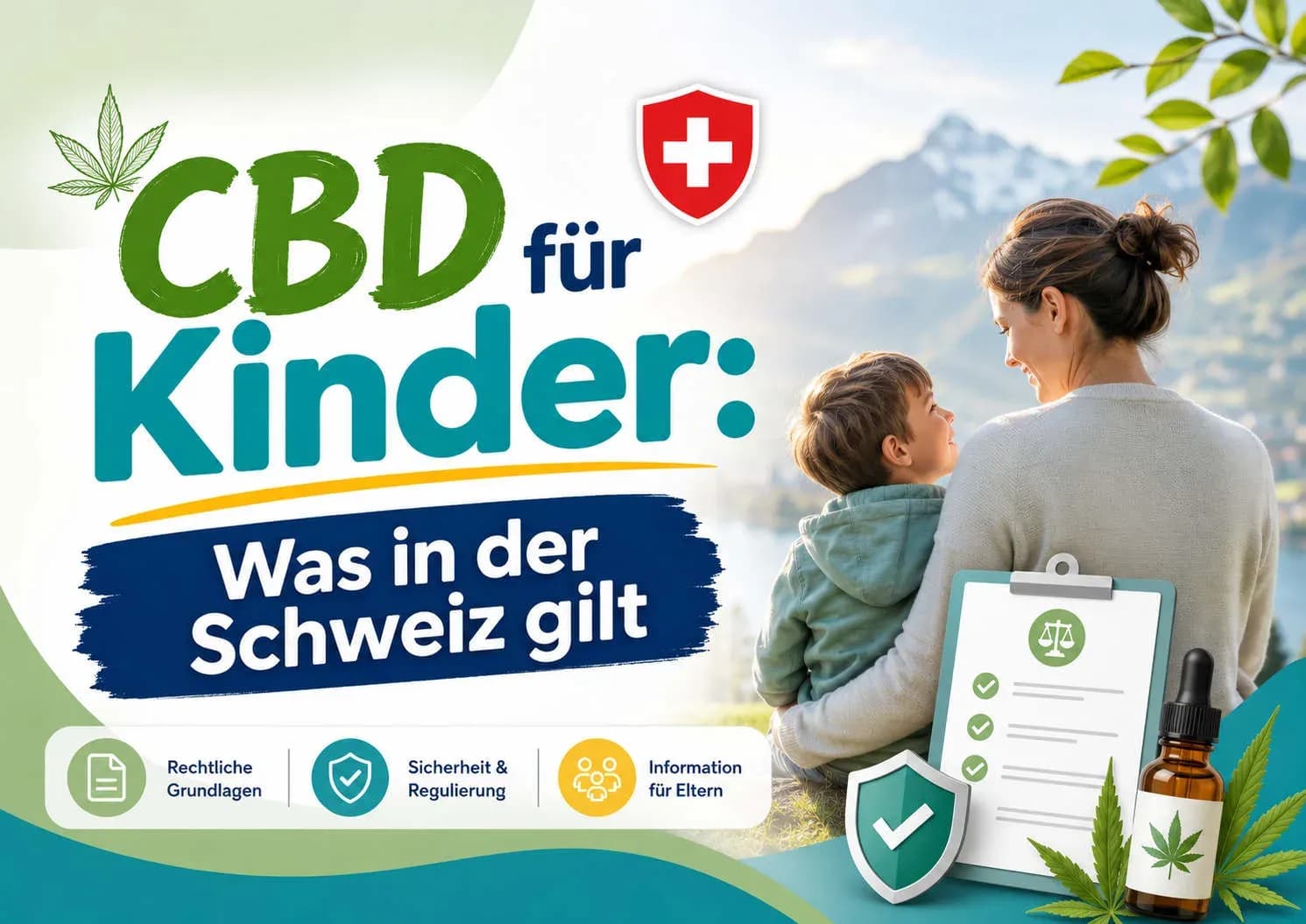
In Switzerland, over-the-counter CBD products are not intended for children and adolescents. The only approved use of cannabidiol in children is the prescription medicine Epidyolex for two rare forms of epilepsy – prescribed and monitored by a specialist doctor.
This article answers the questions parents ask about this topic: what applies legally, what is medically approved, why different standards apply to children and what to do if a child has accidentally got hold of a CBD product. It deliberately contains no product recommendations.
The short answer
Question | Answer |
May I give my child CBD oil? | No – not without a medical prescription |
Is there approved CBD for children? | Yes, just one: Epidyolex, prescription-only, from 2 years of age |
What is it approved for? | Only for Dravet syndrome and Lennox-Gastaut syndrome, two rare forms of epilepsy |
Is it the same as CBD oil from a shop? | No. Different product, different concentration, different controls |
From what age are CBD products permitted? | Over-the-counter products are sold from the age of 18 |
Does CBD help children with ADHD, autism or sleep problems? | There is no approval and no reliable evidence for this. These questions belong in the paediatric practice |
What applies legally in Switzerland
In Switzerland, CBD products are traded in two completely separate categories. This distinction is at the heart of the whole topic.
Medicinal product | Over-the-counter product | |
Example | Epidyolex | CBD oil, flowers, cosmetics in retail |
Approval | Reviewed and approved by Swissmedic | No approval under medicinal products law |
Dispensing | Only with a medical prescription | Freely available, in practice from age 18 |
Active ingredient content | Precisely defined, tested batch by batch | Varies depending on product and manufacturer |
Supervision | Medical monitoring, blood tests, dose adjustment | None |
For children | For a defined indication from 2 years of age | Not intended |
For the general age rules when buying, see the article Age restriction for CBD in Switzerland; for the legal framework as a whole, see the article CBD legal in Switzerland.
Epidyolex – the only approved use in children
Since 2021, a medicinal product containing the active ingredient cannabidiol has been approved in Switzerland. It is called Epidyolex and is an oral solution.
Characteristic | Details |
Active ingredient | Cannabidiol |
Approved since | 2021 in Switzerland |
Indication | Add-on therapy for seizures in Dravet syndrome and Lennox-Gastaut syndrome |
Age | From 2 years |
Dispensing | Prescription-only |
Use | Always in combination with other epilepsy medicines, never alone |
Basis for approval | Four randomised controlled studies with 456 treated patients |
Dosage in the studies | 10 or 20 milligrams per kilogram of body weight per day |
Two points are crucial for parents. First: the approval applies to two rare, severe forms of epilepsy – not to sleep problems, restlessness, difficulty concentrating or other everyday issues. Second: the amounts used in the studies are many times higher than what over-the-counter products contain, and they were administered under close medical supervision.
The Swiss League Against Epilepsy also points out that this medicinal product has side effects as well – including drowsiness, loss of appetite and diarrhoea, occasionally even an increase in seizures – and can interact with other medicines.
Why a retail product is something different
The most common misconception is: if CBD is approved as a medicine for children, a CBD oil from a shop cannot do any harm. This is not true, for several reasons.
● A medicinal product has a precisely defined, tested active ingredient content. With over-the-counter products, the content varies depending on the manufacturer and batch.
● Over-the-counter full-spectrum products contain small amounts of THC. For adults, this is unproblematic below the legal limit; for a child, it is an unnecessary burden.
● A prescription comes with monitoring: blood tests, dose adjustment, observation of interactions. When experimenting at home, all of this is missing.
● A child is not a small adult. The distribution, breakdown and excretion of substances work differently, and the standard cannot simply be scaled down by body weight.
For the difference between the two cannabinoids, see the article Difference between THC and CBD.
Why special caution applies to children
The endocannabinoid system is involved in the development of the nervous system. Among other things, it controls how nerve cells connect and how these connections are shaped during childhood and adolescence. This maturation continues into young adulthood.
The long-term effects of interfering with this system during the developmental phase have not been sufficiently studied. This is precisely the reason for the cautious regulation: not proven harm, but the lack of safety data for a group of people who particularly need protection.
The same logic applies during pregnancy and breastfeeding. There, too, data is lacking, and there, too, the recommendation is to avoid use.
See the article CBD during pregnancy.
Side effects and interactions
The side effects of cannabidiol documented in adults – tiredness, diarrhoea, changes in appetite – also occur in the studies on children. In practice, however, the more critical point is interactions.
CBD inhibits certain liver enzymes through which many medicines are broken down. In a child who is already receiving medication, this can raise the level of these medicines in the body. This is one of the main reasons why use in children belongs in medical hands.
The connections are explained in the article on CBD interactions with medication, and the general overview in the article on CBD side effects.
What parents can do instead
Anyone looking for CBD for a child usually has a specific concern. For each one, there is a more suitable point of contact.
Concern | Right point of contact | Why |
Sleep problems | Paediatric practice | The causes are varied and can usually be resolved without medication |
Restlessness, concentration | Paediatric practice, school psychology service | Assessment before treatment, there are established approaches |
Chronic pain | Paediatric practice, specialist consultation | The cause must be clarified |
Epilepsy | Paediatric neurology | Only there can Epidyolex be prescribed and monitored |
Anxiety, emotional strain | Child and adolescent psychiatry, school social work | Counselling works better here than substances |
Skin problems | Dermatology practice | Clarifying the cause instead of treating symptoms |
Important: if a child has already been given a CBD product, this should be mentioned openly when talking to the doctor. It is not a question of blame, but it is relevant for interactions and for interpreting observations.
If a child has accidentally got hold of a CBD product
This happens – especially with products that look attractive to children, such as gummy bears or flavoured oils. In this case:
Step | What to do | Note |
1 | Stay calm, secure the product | The packaging and label are needed for the consultation |
2 | Call Tox Info Suisse: 145 | Available around the clock, free of charge, from Switzerland and abroad +41 44 251 51 51 |
3 | Note down the amount and the time | Both are the first things you will be asked |
4 | Do not induce vomiting | Never on your own without professional instructions |
5 | Observe the child | In case of impaired consciousness, breathing problems or seizures: emergency number 144 |
As a preventive measure, the same principle applies as with medicines and cleaning products: store out of reach and in the original packaging. For correct storage, see the article on storing CBD products.
Our position
We sell CBD products to adults. Our range is not intended for children and adolescents, and we do not give any usage recommendations for minors – not even on request.
This article exists because parents search for this topic and come across offers that are less cautious. In this case, factual information is a better contribution than silence.
This article provides information on the legal and medical situation. It does not constitute a medical recommendation and does not replace medical advice.
Frequently asked questions
May I give my child CBD oil?
Over-the-counter CBD products are not intended for children and should not be given to minors without a medical prescription. The only approved use in children is a prescription medicine for two rare forms of epilepsy.
From what age can you take CBD?
In Switzerland, over-the-counter CBD products are sold from the age of 18. The only exception is medicines prescribed by a doctor.
What is Epidyolex?
Epidyolex is a prescription medicine containing the active ingredient cannabidiol, which has been approved in Switzerland since 2021. It is used from the age of two as an add-on therapy for seizures associated with Dravet syndrome and Lennox-Gastaut syndrome.
Does CBD help children with ADHD?
There is no approval and no reliable scientific basis for this. If ADHD is suspected, an assessment at the paediatric practice is the right approach.
Is CBD the same as cannabis?
Cannabidiol is one of more than a hundred constituents of the hemp plant and is not intoxicating. The intoxicating cannabinoid is THC. Both come from the same plant but are different substances with different legal classifications.
My child accidentally swallowed CBD oil – what should I do?
Call Tox Info Suisse on 145. The advice service is available around the clock and free of charge. Have the product ready so that the amount and composition can be clarified. In case of impaired consciousness, breathing problems or a seizure, call the emergency number 144.
Sources
Swissmedic: Epidyolex, oral solution (Cannabidiolum) – approval information and Public Summary SwissPAR. swissmedic.ch
Swiss League Against Epilepsy: Is cannabis (hemp) suitable as an epilepsy medicine? epi.ch
Swissmedic: Products containing cannabidiol (CBD) – overview and enforcement guide.
Tox Info Suisse, emergency number 145.
Iffland K., Grotenhermen F. (2017): “An Update on Safety and Side Effects of Cannabidiol”. Published in Cannabis and Cannabinoid Research 2(1):139–154. DOI 10.1089/can.2016.0034
Further articles on the state of research can be found in our overview of CBD studies.
Categories