Products & Strains
How is CBD made? From the hemp plant to finished CBD oil
By Vapor Spirit Fachteam
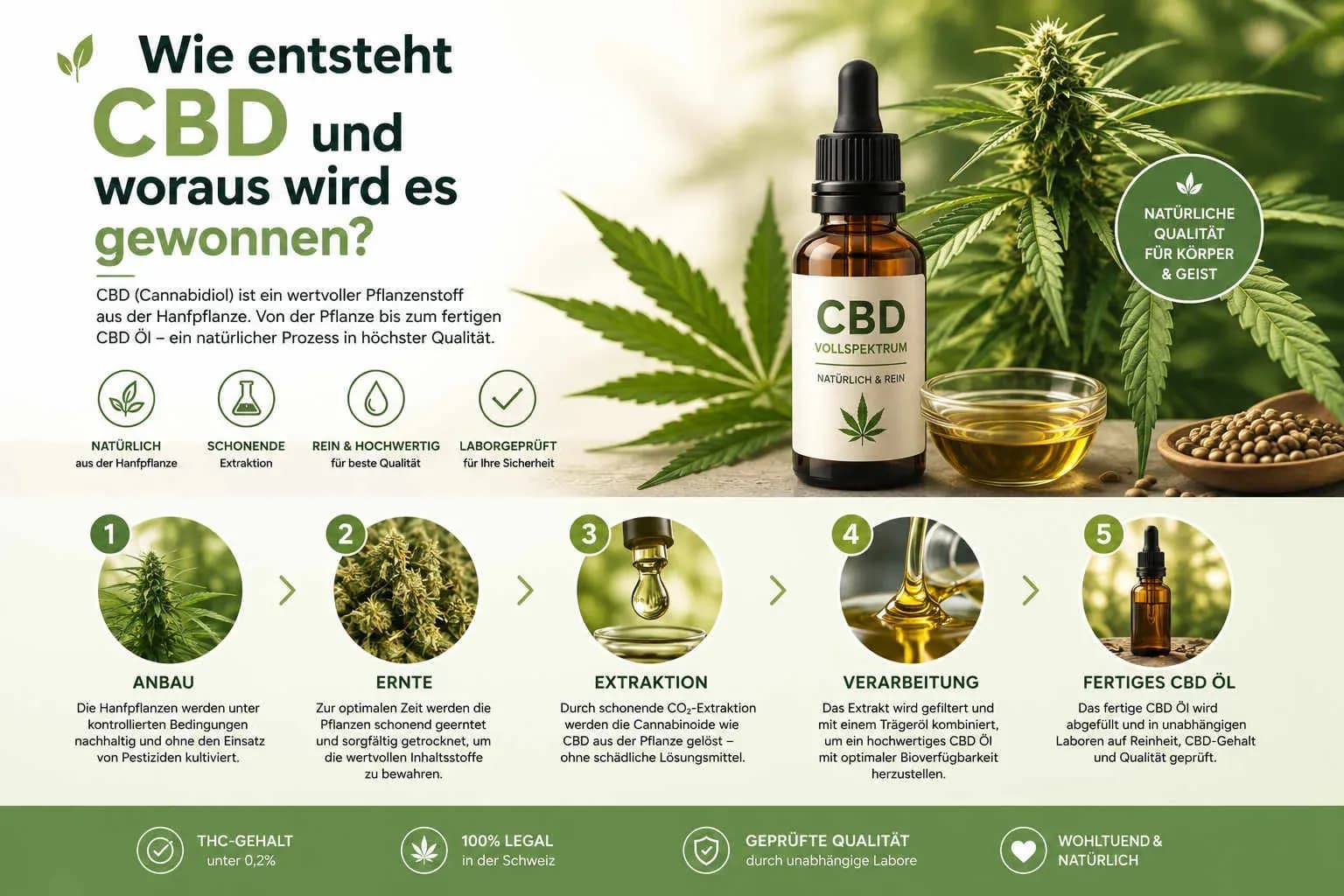
CBD is not formed directly in the hemp plant: the plant first produces the acid form CBDA, which is only converted into CBD by heat – this process is called decarboxylation. To make a CBD oil, the active compounds are then extracted from the flowers, usually by CO2 extraction, and mixed with a carrier oil. In this article you will learn how CBD is formed in the plant, how THC and CBD are formed and how they differ – and how you can make CBD oil yourself.
How is CBD formed in the hemp plant?
It all starts with CBGA, the so-called mother cannabinoid. From this precursor, the plant uses its own enzymes to form the various cannabinoids. The enzyme CBDA synthase converts CBGA into CBDA – the acid form of cannabidiol. A fresh, undried flower therefore contains almost no CBD, but mostly CBDA. Only heat or longer storage causes CBDA to be converted into CBD.
How much CBD a strain ultimately delivers is determined by genetics: CBD-rich industrial hemp strains produce a lot of CBDA and only a little THCA. That is why our Swiss CBD flower is richer in CBD while keeping a low THC content.
How THC and CBD are formed – the key difference
THC and CBD share the same origin: both are formed from CBGA. The enzyme alone makes the difference. If THCA synthase is active, THCA is formed – the precursor of intoxicating THC. If CBDA synthase is active, CBDA is formed and with it the basis of CBD. Which enzyme a plant mainly produces is genetically determined and cannot be reversed by the cultivation method.
In practice, this means: legal Swiss hemp strains are bred to contain hardly any THC – the legal limit is below 1 percent, so the products can be sold freely in Switzerland. You can read more about the legal situation in our article Is CBD legal in Switzerland?.
Decarboxylation: how CBDA becomes CBD
Decarboxylation is the key step in producing CBD. Under the influence of heat, a carbon dioxide group splits off from the CBDA molecule – what remains is CBD. Temperature is decisive: at a low temperature the process is slow but gentle. At too high a temperature, the sensitive terpenes evaporate and some of the active compounds are lost. As a guideline, around 110 to 120 degrees for about 40 minutes is recommended.
This same effect is also relevant when vaporizing – our article Smoking or vaporizing CBD flower explains how to choose the right temperature.
How is CBD oil made? Professional oil production
For a finished CBD product, the active compounds must be extracted from the plant material. An overview of the three common methods of oil extraction:
Method | How it works | Result |
CO2 extraction | Carbon dioxide extracts the active compounds from the flowers under controlled pressure | Very pure CBD extract, gentle on cannabinoids and terpenes – industry standard |
Alcohol extraction | Ethanol dissolves the plant compounds, then the solvent is removed | High yield, requires careful post-processing |
Oil extraction | Flowers are infused in fat at a low temperature | Simple method, also possible at home – but the content cannot be determined exactly |
After extraction, the CBD extract is brought to the desired concentration with a carrier oil – often hemp seed oil, olive oil or MCT oil. Our comparison of MCT oil vs. hemp seed oil shows which carrier oil offers which advantages. This results in CBD oils with a reproducible content, whose composition of cannabinoids and terpenes is tested in the laboratory – the article on CBD lab analysis explains how to read such a certificate.
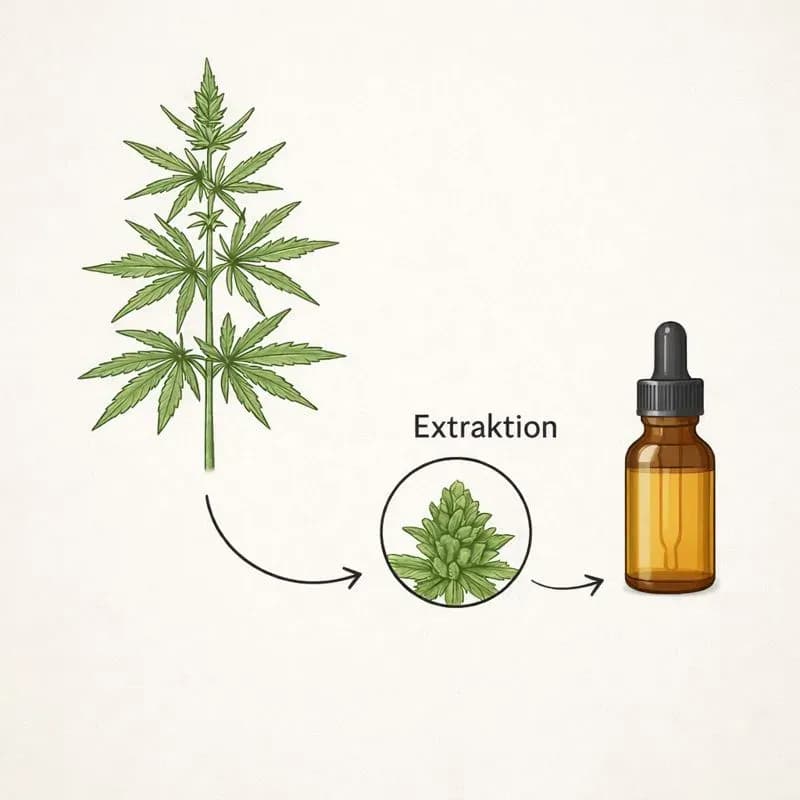
Making CBD oil yourself – step-by-step guide
If you want to make CBD oil yourself, use the simple method of fat extraction. It requires no technical equipment and works completely without alcohol. The prerequisite is legal CBD flower with a low THC content. Here is how to make CBD oil at home:
Step | What you do | Temperature / time |
1 | Coarsely chop the CBD flower (do not grind it to a powder) | — |
2 | Decarboxylate: heat the flowers on baking paper in the oven so that CBDA is converted into CBD | approx. 110–120 °C, around 40 minutes |
3 | Place the flowers with the carrier oil in a heat-resistant jar (approx. 10 g of flowers per 250 ml of oil) | — |
4 | Let the jar steep in a water bath, stirring occasionally | approx. 70–80 °C, 2–3 hours |
5 | Strain through a fine sieve or cloth | — |
6 | Pour into a dark glass bottle and store in a cool place away from light | keeps for about 1 month to a few months |
Important: without the decarboxylation step, most of the CBDA remains and is not converted into CBD – the finished oil then contains hardly any active cannabidiol.
Making CBD oil yourself with olive oil, coconut oil or MCT oil
The fat you choose affects taste, shelf life and consistency:
Making CBD oil yourself with olive oil: strong, fruity taste, widely available, rich in antioxidants. Ideal for anyone who likes the Mediterranean character.
Making CBD oil yourself with coconut oil: high proportion of saturated fatty acids, very long shelf life, becomes solid at room temperature – practical for creams and balms.
Making CBD oil yourself with MCT oil: neutral in taste, stays liquid, is absorbed quickly by the body – the most common choice for drops.
Limits of making it yourself
As exciting as the experiment is: how much CBD is actually in the finished oil cannot be measured at home – the dosage remains an estimate. Purity and shelf life cannot be checked without laboratory analysis either. If you want to dose precisely, you are therefore better off choosing a tested product: our organic CBD oils from Swiss production are gently produced and analysed in an independent laboratory for every batch. You can find out how to dose them correctly in the guide to CBD oil dosage.
Frequently asked questions about how CBD is made
How is CBD oil made industrially?
The flowers are decarboxylated and the active compounds are usually extracted by CO2 extraction. The resulting CBD extract is then diluted with a carrier oil to the desired concentration.
Does CBD flower naturally contain CBD?
No, fresh flowers mainly contain CBDA. Only heat converts CBDA into CBD – which is why decarboxylation is a central step in oil production.
Is homemade CBD oil legal in Switzerland?
Production for personal use from legally purchased flowers with less than 1 percent THC is permitted. The sale of homemade oils, however, is subject to strict requirements.
How long does homemade CBD oil keep?
Stored in a cool, dark place and tightly sealed, it usually keeps for about 1 month to a few months. A rancid smell is a sign that you should discard it.
Can THC be formed accidentally when making it yourself?
No. How much THC it contains depends solely on the original strain. CBD-rich flowers with a low THC content do not produce any additional THC, even when heated.
Conclusion: CBD is formed by way of CBDA – only heat turns it into the cannabidiol we know. Whether you try making CBD oil yourself or choose a finished product: what matters is the quality of the source flowers and gentle processing. You will find both in our CBD shop.
Note: CBD products are not medicines and do not replace medical advice. This article is for general information only and refers to the legal situation in Switzerland. Sold to adults only. Last reviewed: July 2026.
Categories