Law & Safety
CBD Law, Safety and Legality in Switzerland – the Complete Guide
By Vapor Spirit Fachteam
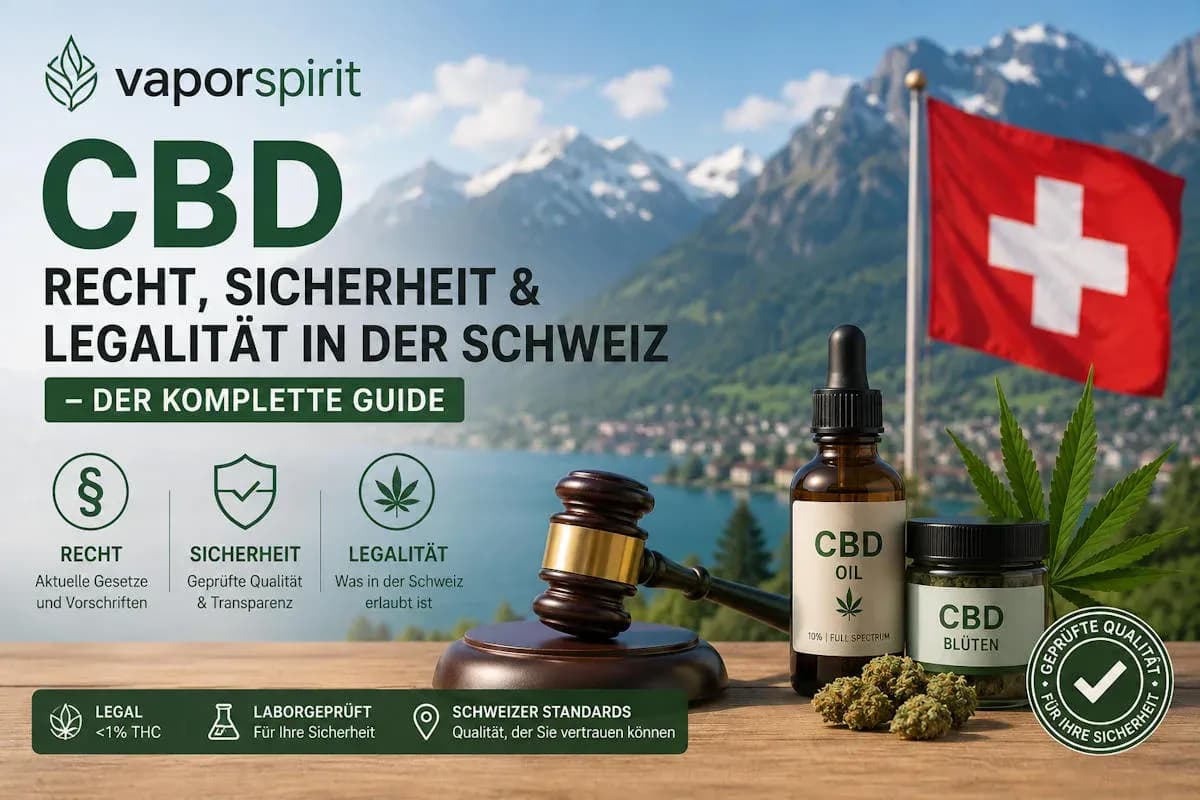
CBD has been legally available in Switzerland for years – but what does that mean in concrete terms? Which THC limit applies? Are you allowed to drive after using CBD? And what should you look out for when buying? This guide gives you a comprehensive, neutral overview of the legal situation around CBD in Switzerland – easy to understand, up to date and without legal jargon.
Is CBD legal in Switzerland?
Yes – CBD is legal in Switzerland as long as the THC content is below 1 %. This makes Switzerland particularly liberal by international standards: in the EU the limit is usually 0,2 % or 0,3 %, whereas in Switzerland up to 1,0 % tetrahydrocannabinol (THC) is permitted. This rule is based on the Swiss Narcotics Act (BetmG) and ensures that CBD products cannot have an intoxicating effect.
Which THC limit applies to CBD products?
The 1 percent rule is the central criterion for legal CBD products in Switzerland. Specifically, this means: hemp flowers, CBD oils, liquids and extracts may contain a maximum of 1,0 % THC. If this value is exceeded, the product is considered a narcotic and can no longer be sold freely. Reputable suppliers have their products tested regularly in independent Swiss laboratories and provide the certificates of analysis (CoA).
Can I drive after using CBD?
Caution: Even though CBD itself is legal and not psychoactive, consuming CBD products can become problematic in road traffic. The reason: even small amounts of THC are detected in traffic checks. In Switzerland, there is zero tolerance for THC at the wheel. If you consume CBD flower or highly concentrated full spectrum oil , you can test positive – regardless of whether there was an intoxicating effect. Recommendation: do not drive a vehicle after consuming CBD products that may contain THC. If you have to drive regularly, it is better to choose THC-free products.
What should I look out for when buying legal CBD products?
When buying CBD in Switzerland, you should look out for the following quality and safety features: transparent laboratory analyses of every batch, Swiss or European cultivation without pesticides, clear declaration of CBD and THC content, an unambiguous list of ingredients and a reputable company registered in Switzerland. Be careful with extremely cheap products of unclear origin – here the risk of contamination or excessive THC levels is higher.
CBD in the workplace – what is allowed?
Since CBD is legal and has no intoxicating effect, there is no general restriction for most professions. The situation is different for safety-critical activities, however: professional drivers, pilots, security staff or employees with machine operator licences should be careful because of residual THC levels. The same applies to drug tests in a work context. If in doubt, it is worth checking your employment contract or talking to the HR department.
CBD and travel – what applies abroad?
The legal situation regarding CBD differs considerably from country to country. In Germany, Austria, Italy and France, significantly lower THC limits apply to CBD products than in Switzerland (usually in the range of 0,2 to 0,3 %), sometimes with additional restrictions. In some countries, such as Singapore, Japan or certain Gulf states, even low-THC CBD is strictly prohibited. If you travel abroad with CBD, you should inform yourself in advance – ideally directly with the embassy of the destination country – and, if in doubt, leave CBD products with a measurable THC content at home.
Safety and quality standards in Switzerland
Swiss CBD products are among the highest-quality products in the world. The reason: strict requirements for cultivation, processing and sale. The hemp is often grown to Bio Suisse or Demeter standards, without pesticides and with labour-intensive harvesting by hand. Processed products are subject to the requirements of food law or the tobacco tax ordinance – depending on the form of use. As a consumer, look out for transparent information on origin, organic certificates and independent test reports.
CBD flowers, oils, liquids – different legal classifications
Not all CBD products are treated the same way legally. In Switzerland, CBD flower is considered a tobacco substitute product and is subject to tobacco tax. CBD oils are usually declared as aroma or fragrance products or as cosmetics, as CBD requires novel food authorisation as a food ingredient. CBD liquids for e-cigarettes are considered tobacco substitute products. Cosmetics containing CBD must comply with cosmetics law requirements. Important: health and efficacy claims are prohibited by law for all CBD products – regardless of the product form.
In-depth topics on CBD and the law
If you want to go deeper into individual aspects, you will find further articles: detailed instructions on the right dosage: CBD Dosage & Intake Guide. Which products and suppliers are particularly recommended: Best CBD shop in Switzerland. Effects and properties of the cannabinoid: How does CBD work in the body. Background on cultivation and production: Swiss organic CBD hemp.
FAQ – the most important questions about CBD law in Switzerland
Can CBD be sold freely in Switzerland? Yes, as long as the THC content is below 1 % and no health claims are made. CBD oils, flowers and liquids are freely available in specialist shops and online.
Do I need a prescription for CBD? No. No prescription is needed for commercially available CBD products with less than 1 % THC. The situation is different for medical cannabis with a higher THC content – this requires a medical prescription.
Can CBD cause a positive drug test? Pure CBD isolate does not. However, full spectrum products contain traces of THC that can lead to a positive result in sensitive tests. If you are tested regularly, you should prefer isolates or broad spectrum products.
From what age can CBD be bought? Smokable products such as flower and liquids are considered tobacco substitute products; a minimum age of 18 applies to them throughout Switzerland. Vaporspirit sells CBD products only to persons aged 18 and over.
Can I grow CBD myself? Private cultivation of hemp plants with a THC potential of over 1 % is not permitted in Switzerland. Only certified varieties with less than 1 % THC may be grown under strict conditions – in practice this is hardly feasible for private individuals.
Are CBD foods legal? The Federal Food Safety and Veterinary Office (BLV) takes a cautious approach to CBD as an additive in food. Many foods containing CBD are classified as novel food and are only permitted to a limited extent. Aroma products, on the other hand, are generally permitted.
Conclusion: CBD in Switzerland – legal, safe and used wisely
Switzerland offers one of the most liberal and at the same time safest legal frameworks for CBD worldwide. If you rely on quality, transparency and reputable suppliers, you can use CBD without worry – whether as CBD oil, flower or liquid. It is important to know the legal cornerstones: the 1 % THC limit, zero tolerance in road traffic, a clear duty of declaration and caution when travelling abroad. If you keep these points in mind, you benefit from a mature Swiss CBD market with high-quality products. For Swiss premium quality with transparent laboratory analyses, you will find a carefully curated selection at Vaporspirit, since 2015.
If you are interested not only in the legal framework but also in how CBD works: in our comprehensive CBD Effects & Areas of Use Guide we explain how CBD acts in the endocannabinoid system and which areas of use are being discussed.
Categories