Shop & Buying Advice
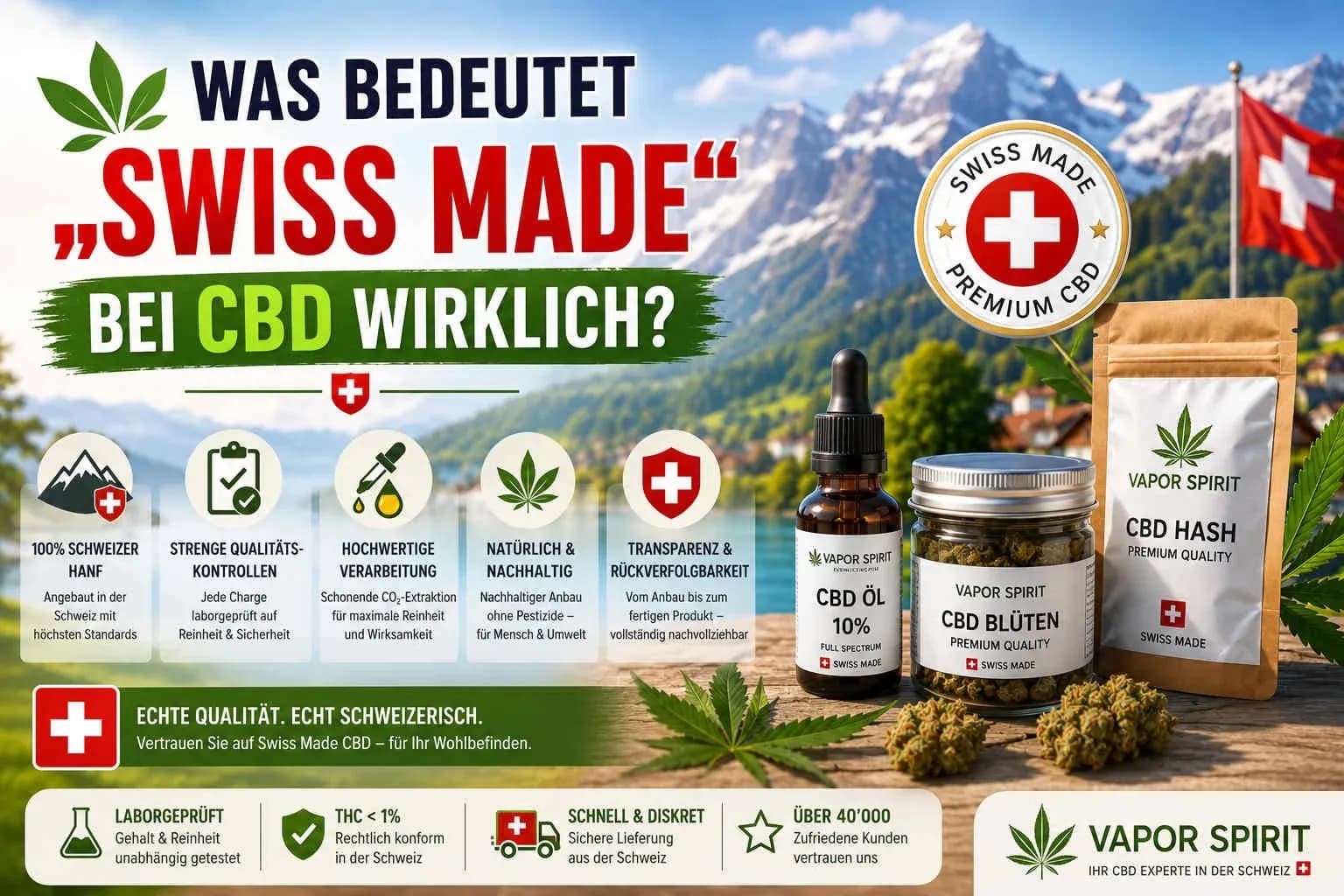
What does “Swiss Made” really mean for CBD?
By Vapor Spirit Fachteam
Swiss Made CBD: what the Swiss promise of quality really means
For CBD, “Swiss Made” is not just a marketing term but is regulated by law: for a food to carry this label, at least 80 percent of the raw material weight must come from Switzerland and the essential processing step must take place in the country. For industrial products such as cosmetics, the threshold is 60 percent of the manufacturing costs. For you as a customer, this means: Swiss Made CBD stands for traceable origin, strict controls and the Swiss THC limit of less than 1 percent – provided the supplier can prove it.
What “Swiss Made” means legally
Since the Swissness legislation, the Swiss cross and the indication of origin “Switzerland” may no longer be used freely. Different requirements apply depending on the product category:
Product category | Requirement for “Swiss Made” | Example for CBD |
Food | At least 80 % of the raw material weight from Switzerland, plus the essential processing step in the country | CBD oil declared as a food or aroma product |
Industrial products | At least 60 % of the manufacturing costs are incurred in Switzerland | Vaporizers, accessories |
Cosmetics | Considered industrial products – 60 percent rule plus processing in the country | CBD creams and ointments |
Natural products | The place of harvesting is decisive | CBD flower from Swiss cultivation |
Important to know: a product whose raw material was grown abroad and merely bottled in Switzerland generally does not meet these criteria. This is exactly where genuine Swiss Made CBD differs from mere cosmetic labelling.
Why origin matters especially for CBD
Hemp is a plant that absorbs substances from the soil – including heavy metals and pesticide residues. In agriculture, this is even called phytoremediation, because hemp literally cleans contaminated soils. For a consumer product, this means: the place of cultivation directly determines the purity of the end product.
Swiss cultivation brings clear advantages here: controlled soils, strict rules for pesticides, clean water quality and complete documentation from the field to the bottle. How these values are checked in the laboratory is explained in our article on CBD laboratory analysis.
The Swiss legal situation: the 1 percent limit
Switzerland is one of the most liberal CBD markets in Europe. Products here are not considered narcotics as long as the total THC content is below 1 percent. In the EU, depending on the country, it is only 0,2 to 0,3 percent. This difference is not a formality: Swiss strains may have a fuller cannabinoid profile, which affects aroma and the perceived effect.
At the same time, clear limits apply: CBD products are not remedies and must not be advertised with health claims. Different regulations apply depending on whether they are declared as an aroma product, a cosmetic or a smoking product. You can find all details in the article Is CBD legal in Switzerland?.
How to recognize genuine Swiss Made CBD
A reputable supplier makes the origin verifiable instead of merely claiming it. You should check these five points before you buy.
First: is the place of cultivation named specifically – i.e. the canton or the farm – or does it just vaguely say “from Switzerland”? Second: is there a certificate of analysis from an independent laboratory for every batch that shows not only the CBD content but also heavy metals and pesticides? Third: does the batch number on the certificate match the one on your product?
Fourth: is the declaration complete, including the carrier oil, extraction method and THC content? And fifth: does the supplier physically exist, with an address, a shop and a reachable customer service? You can reach our team by phone or WhatsApp, and our shop is at Rosengartenstrasse 3 in Zurich – find out more on the about us page.
Swiss Made CBD compared with imported goods
The price difference between Swiss and imported products has concrete reasons. The following overview shows what the extra cost stands for:
Feature | Swiss Made CBD | Imported goods |
THC limit | Below 1 % under Swiss law | EU mostly 0,2–0,3 % – strains and effect profile differ |
Control | Cantonal laboratory spot checks, clear declaration requirements | Varies greatly depending on the country of origin |
Traceability | Farm and batch can usually be named | Often only the importer is known |
Transport routes | Short, no customs | Long, customs clearance possible |
Laboratory analyses | Usually available for each batch | Sometimes only collective analyses or none at all |
One step above Swiss Made: Bio Suisse and Demeter
Swiss Made says something about origin, but nothing about the cultivation method. If you want both, also look for organic certifications. The Bio Suisse bud label requires organic cultivation without synthetic pesticides and artificial fertilizers. Demeter, as a biodynamic standard, goes even further and sets requirements for the entire agricultural cycle.
Our organic CBD oils and CBD flower come from Swiss cultivation according to Bio Suisse and Demeter guidelines. This combination – Swiss origin plus certified organic cultivation – is still rare on the CBD market.
From field to bottle: the journey of a Swiss CBD oil
After harvesting, the flowers are gently dried and cured. The active compounds are then extracted, usually with a CO2 process, and brought to the desired concentration with a carrier oil. You can read how this process works in detail and why temperature is decisive in the article How is CBD made?.
Each finished batch then goes to an independent laboratory. Only once the cannabinoid content, THC value and absence of contaminants have been confirmed does it go on sale. You can find the complete range in our CBD shop.
Frequently asked questions about Swiss Made CBD
Is “Swiss Made” legally protected for CBD?
Yes. The indication of origin is subject to the Swissness legislation. For food, at least 80 percent of the raw material weight must come from Switzerland; for industrial products, at least 60 percent of the manufacturing costs.
Is it enough for CBD oil to be bottled in Switzerland?
No. Bottling alone is not considered an essential processing step. What matters is the origin of the raw materials and the place of the value-adding processing.
Why is Swiss CBD more expensive than imported goods?
Higher wages, stricter cultivation rules, organic certifications and laboratory analyses for each batch are reflected in the price. In return, origin and purity are traceable.
Does the Swiss THC limit also apply abroad?
No. In the EU, the limits are 0,2 to 0,3 percent. A product that is legal in Switzerland can be problematic when taken out of the country – find out about the rules of the destination country before you travel.
How can I tell that a certificate of analysis is genuine?
It comes from an independent, accredited laboratory, states the analysis date and batch number, and shows heavy metals and pesticides in addition to the cannabinoids.
Is Swiss Made automatically organic?
No. Swiss Made refers to origin, not to the cultivation method. For organic cultivation, you also need a certification such as Bio Suisse or Demeter.
Conclusion: for CBD, Swiss Made is a reliable quality signal – but only if it is backed by verifiable information. If in doubt, ask for the certificate of analysis and the place of cultivation. Anyone who provides both transparently has nothing to hide.
Note: CBD products are not remedies and do not replace medical advice. This article is for general information only and refers to the Swiss legal situation. Sale to adults only. Last reviewed: July 2026.
Categories