Shop & Buying Advice
Indica vs sativa difference: effects, appearance and terpenes
By Vapor Spirit Fachteam
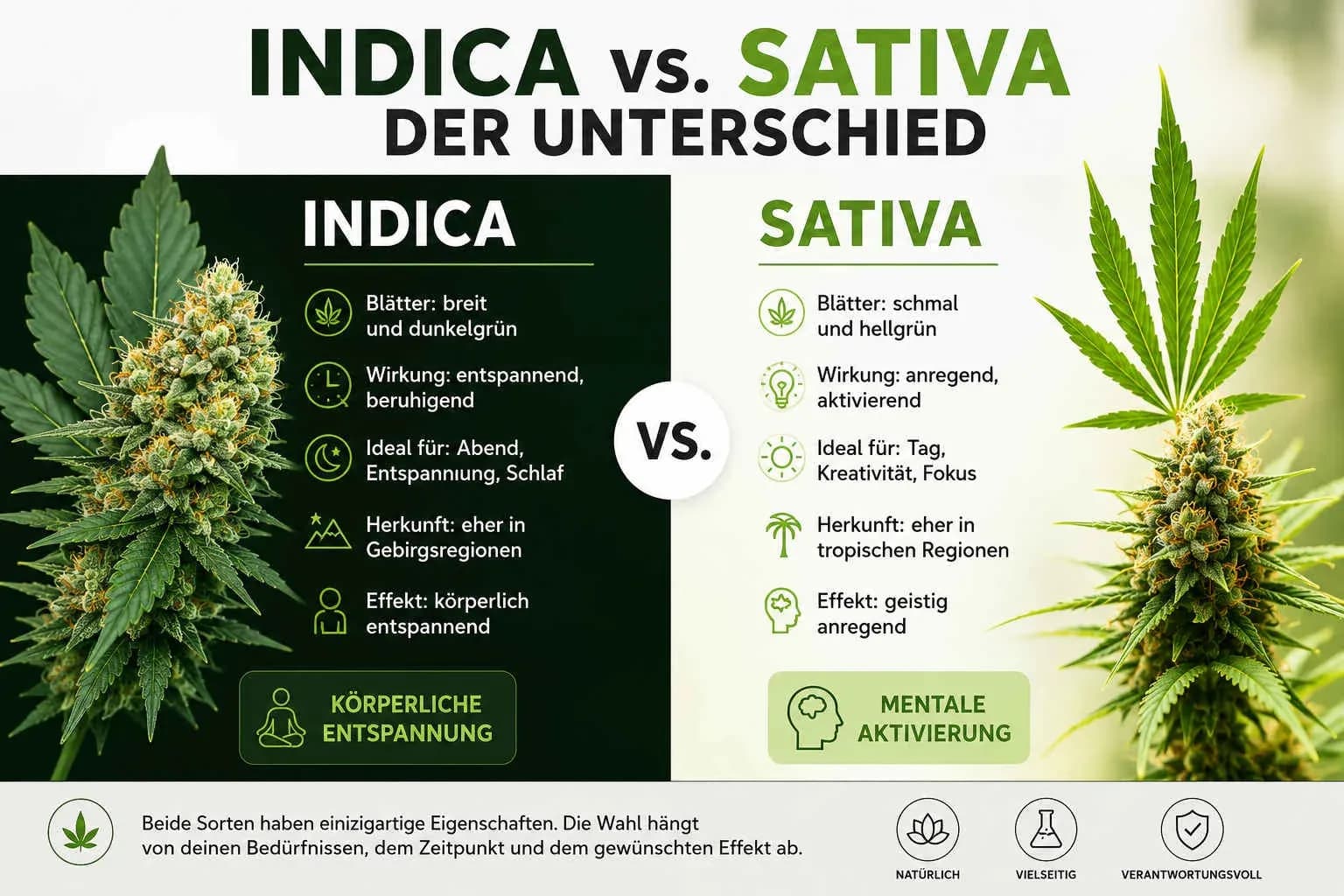
In short: Indica and sativa are two botanical subspecies of the cannabis plant. Traditionally, indica grows short and bushy with broader leaves and is associated with physical relaxation, while sativa grows tall and slender with narrower leaves and is described as more stimulating. Modern research, however, shows that it is not the classification into indica vs. sativa that determines the effect, but the chemical profile of cannabinoids and terpenes of the respective strain.
If you look into cannabis or CBD, sooner or later you will come across the terms sativa and indica. But what does sativa actually mean, what is indica – and what is the real difference between sativa and indica? In this guide we explain the indica sativa difference, from botany and history to the latest scientific findings.
What are indica and sativa?
Sativa and indica refer to two different subspecies of the cannabis plant, which differ in origin, appearance and the effects attributed to them. Both belong to the genus Cannabis, but developed over centuries in different climate zones.
What is sativa?
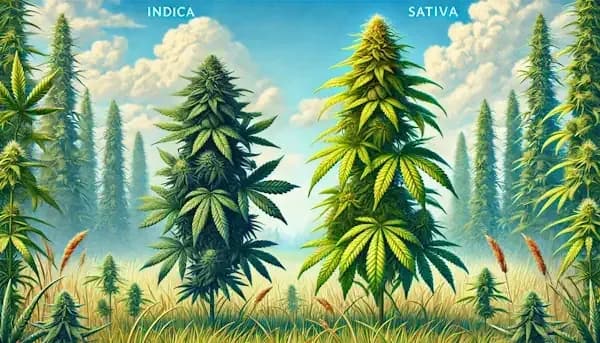
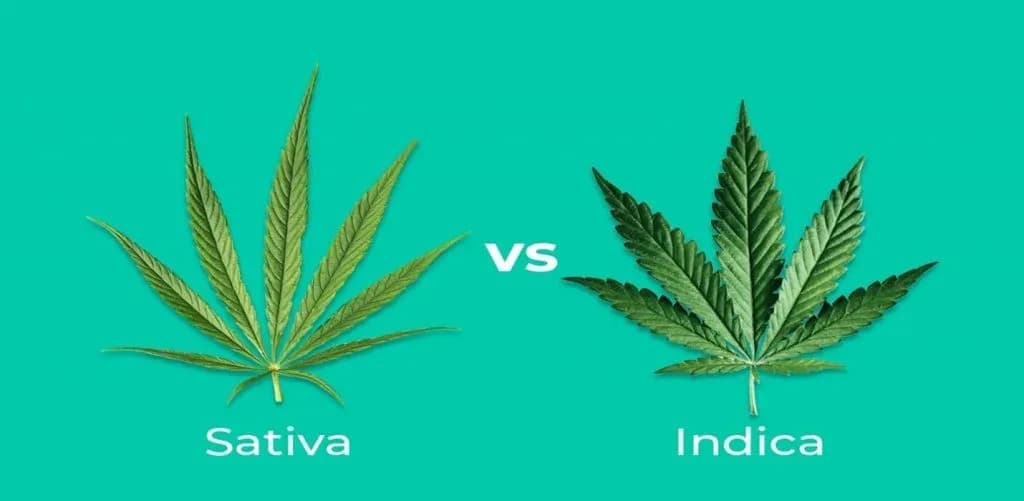
Cannabis sativa originally comes from warm regions near the equator – for example parts of Asia, Africa and Central America. Sativa plants grow tall (sometimes over two metres), are slender and have long, narrower leaves. They need more time to mature and are traditionally associated with stimulating, invigorating effects – the so-called “head high”.
What exactly does indica mean?
Cannabis indica is originally native to the mountainous regions of Afghanistan and Pakistan (Hindu Kush). Indica plants are smaller, more compact and bushier and have broader leaves. They mature faster and are often associated with deep relaxation, a “body high” and calming, relaxing effects. CBD flower
The history: where do the terms come from?
The distinction is more than 250 years old. In 1753, the Swedish botanist Carl von Linné (Linnaeus) assigned the name Cannabis sativa to what he considered the only species of the genus. A good three decades later, in 1785, the French biologist Jean-Baptiste de Lamarck identified Cannabis indica as a separate species, distinct from Cannabis sativa.
Lamarck based his classification mainly on physical differences: narrow, dark green leaves and denser branching in indica. He also noted that indica had a stronger intoxicating effect – and was thus the first to establish a link between the effect of cannabis and the appearance of the plant. This historical classification still shapes how people talk about indica vs sativa today.
Indica vs. sativa: the difference at a glance
The following table summarises the classic difference between sativa and indica based on the common characteristics:
Characteristic | Cannabis sativa | Cannabis indica |
Origin | Warm regions near the equator | Mountain regions of Afghanistan & Pakistan |
Growth | Tall, slender, up to over 2 m | Short, compact, bushy |
Leaves | Long and narrow (narrower leaves) | Short and wide (broader leaves) |
Maturation time | Longer | Shorter |
Attributed effect | Stimulating, “head high”, creative | Calming, “body high”, physical relaxation |
Typical use | During the day | In the evening |
Important: This table describes the traditional understanding. As the next section shows, the appearance of a plant alone says little about its actual effect.
What is the difference between indica and sativa according to research?
This is where it gets interesting – and where well-founded knowledge stands apart from half-knowledge. Although many consumers distinguish between the effects described, these different effects are not clearly proven scientifically.
Several studies show that the chemical composition of a strain is more decisive than its botanical classification:
- Hillig & Mahlberg (2004) did find genetic differences between sativa and indica populations – but their chemical profiles overlap considerably.
- Using genetic analyses, Sawler et al. (2015) showed that most modern strains are hybrids and carry genes from both lines.
- Hazekamp et al. (2016) emphasised that the terms “sativa” and “indica” no longer allow any reliable conclusion about effect or chemistry.
In other words: neither leaf shape nor plant height reliably reveals how a strain will work.
What counts is the individual interaction of cannabinoids and terpenes.
Why the effect really depends on the chemical profile
Two groups of substances are mainly responsible for the actual different effects:
- Cannabinoids such as THC and CBD
- Terpenes – the aromatic compounds of the plant
This is known as the “entourage effect”: cannabinoids and terpenes influence each other and together shape the effect profile. A sativa plant grown in a new climate can develop a completely different chemical profile – and then have an effect more like a typical indica.
Terpenes such as myrcene: the real drivers
Terpenes such as myrcene play a central role. Myrcene is often found in strains considered calming and is associated with relaxing properties. Other well-known terpenes:
Terpene | Aroma | Often associated with |
Myrcene | Earthy, musky | Relaxation, calm |
Limonene | Citrus | Improved mood, clarity |
Pinene | Pine | Alertness, focus |
Linalool | Floral (lavender) | Calm |
Caryophyllene | Spicy, peppery | Relaxation |
This is exactly why research is increasingly adopting a classification by chemotypes (chemical profiles) instead of the rigid division into sativa vs. indica.
THC and CBD: the decisive cannabinoid difference
Apart from the sativa-indica question, the ratio of THC and CBD is often more meaningful for the effect you can expect:
- THC is the psychoactive cannabinoid. Strains with a higher THC content are intoxicating.
- CBD is not psychoactive. Strains with high CBD levels are associated with a relaxed feeling without being intoxicating.
In Switzerland the legal framework is clear: cannabis products are legally available as long as the THC content is below 1 %. Accordingly, with legal Swiss products the focus is on the CBD content and the terpene profile – not on a high THC level.
Sativa, indica – and Cannabis ruderalis
In addition to the two well-known subspecies, there is a third: Cannabis ruderalis. This robust, small variety comes from northern regions and flowers independently of the light cycle (“autoflowering”). Ruderalis naturally contains little THC and is mainly crossed in by breeders to create easy-care strains with stable flowering behaviour.
Hybrid strains: the best of both worlds
Pure sativa or pure indica strains are rare today. The vast majority of modern hybrid strains combine characteristics of both lines:
- Sativa-dominant hybrids retain the more stimulating character of the sativa parent, but in a more moderate form.
- Indica-dominant strains keep the calming tendency of the indica side, but offer a more balanced experience than pure indica.
Well-known examples: Sour Diesel (sativa-leaning) is considered a classic example of a stimulating character, while many Kush varieties are indica-leaning. With hybrids, it is always worth looking at the specific terpene and cannabinoid profile rather than just the label.
Which is better for sex: sativa or indica?
One of the most frequently asked questions – and the honest answer is: it depends. Neither sativa nor indica is generally “better”, because the effect depends heavily on the individual chemical profile and personal reaction. As a rough guide, many users follow this rule of thumb:
Goal | Frequently chosen type | Reason (reported) |
Calm, sensual intimacy | Indica-leaning | Physical relaxation, heightened body awareness |
Energetic, playful mood | Sativa-leaning | Stimulating, mood-lifting tendency |
Balanced experience | Hybrid | Combination of both directions |
Many report that terpenes such as myrcene (often in indica-leaning strains) intensify body awareness, while sativa-leaning strains rich in limonene and pinene are more associated with an alert mood. Important: a very high dose or a very high THC content can rather be a hindrance. If you want to avoid the intoxicating effect, choose products with high CBD levels. Cannabis is neither a remedy nor a potency aid – for health questions, medical advice is the right place to turn.
Indica, sativa and CBD: what does this mean for you?
For the legal Swiss market: instead of relying solely on “indica vs” or “vs sativa”, it is worth looking at the complete profile of a strain – cannabinoids and terpenes, CBD content and origin. This is exactly what we pay attention to when selecting our Bio Suisse and Demeter certified CBD flower.
Whether you are looking for a relaxing, indica-leaning note or a fresh, sativa-leaning aroma: in the Vaporspirit range you will find carefully selected strains with transparently declared profiles. That way you choose not based on myth, but on what really counts.
👉 Discover our CBD shop
Frequently asked questions (FAQ)
What does sativa mean?
Sativa refers to a subspecies of the cannabis plant that originally comes from warm regions near the equator. Sativa plants grow tall and slender with narrower leaves and are traditionally associated with stimulating effects.
What is indica?
Indica is a cannabis subspecies from the mountain regions of Afghanistan and Pakistan. Indica plants are short and bushy with broader leaves and are associated with physical relaxation.
What is the difference between sativa and indica?
Traditionally, they differ in origin, growth form and leaf shape as well as in the effects attributed to them (stimulating vs. relaxing). Modern research shows, however, that the chemical profile of cannabinoids and terpenes determines the actual effect more strongly than the botanical classification.
Which is better for sex: sativa or indica?
That depends on the desired experience and the individual chemical profile. Indica-leaning strains are more associated with calm relaxation, sativa-leaning strains more with a stimulating mood. There is no general recommendation.
Can indica and sativa be clearly distinguished scientifically?
There are genetic differences, but the chemical profiles overlap considerably. Studies show that the terms alone do not allow any reliable conclusion about the effect – what matters are cannabinoids and terpenes.
What is Cannabis ruderalis?
A third, small cannabis subspecies with a low THC content, which flowers independently of the light cycle and is often crossed in to create easy-care hybrids.
Note: This article is for general information purposes only and does not constitute a health or healing claim. In Switzerland, CBD products with less than 1 % THC are legally available.
Learn about the differences between indica and sativa: the characteristics,
effects and areas of use of the two cannabis types.
The choice between sativa and indica can make a big difference
when it comes to the desired experience or the intended effect. Sativa plants
are known for their invigorating and creative properties, while indica plants
are preferred for relaxation and stress relief. Both have unique characteristics in
terms of their effect, origin and chemical composition.
- Kassensturz regularly rates the best CBD products in Switzerland.
- CBD oil test winner Switzerland
Note
This article is intended solely for general information and does not constitute
medical advice. Cannabidiol (CBD) is not a medicine. No
healing or health claims are made.
Legal notice (Switzerland)
CBD products are legal in Switzerland provided the THC content is below 1 %.
The content refers exclusively to the legal situation in Switzerland.
Disclaimer
In the event of health complaints, a medical professional should always
be consulted.
Categories